With the pandemic continuing throughout 2021, it was another highly unusual year for cinema, as movie theaters here in New England faced lengthy (and often quite sudden) shutdowns and hesitant re-openings as public health parameters shifted locally and globally. Some cinemas and theater chains didn’t survive those changes and the subsequent loss of film audiences when more people retreated to streaming films online at home. Somehow, I was able to keep myself going to see movies in person at cinemas throughout nearly the entire year, though the rollout of worthwhile new films was slow and halting, as film companies carefully measured and re-calibrated what might be worth releasing and when. Release schedules continued to get jostled around as film releases were postponed and timed for when they might get the best kind of audience response at the box office. Therefore, as with my year-end post for 2020, just three movies lingered with me most throughout 2021, and in each case, I was drawn to them as much for their subtle emotional pull as for their narrative and visual craft. I felt like these movies spoke to my own levels of sadness at the ongoing state of the world and offered some consolation and distant yet intimate company via their artistry.
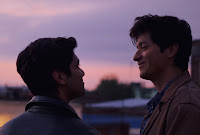
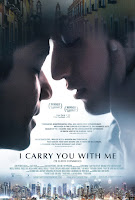
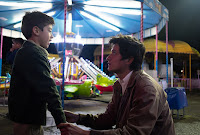
It’s fitting that Heidi Ewing’s moving and relatively little-seen gay Mexican immigrant romantic saga I Carry You with Me was my favorite movie in a year when Jane Campion’s much-lauded, quasi-gay Western tragic epic The Power of the Dog could win Best Picture (and Best Director) at the Oscars. While Campion’s novel-like film is certainly finely made, intricately deployed, and superbly acted, its mystifying effect on the mostly straight audience that I saw it with seemed to be its intended goal, whereas a gay male viewer like me could easily see the planted curveballs coming. I Carry You with Me has fewer tricks up its sleeve, perhaps because it wears its heart more openly there, which isn’t to say that it’s a simple story, nor one that’s simply conceived. Based on the actual relationship of two of Ewing’s gay friends, Iván (Armando Espitia) and Gerardo (Christian Vásquez), a chef and a teacher, respectively, the film follows the two young men from their initial meeting at a club in Puebla, Mexico in the ’80s through their struggles to immigrate to New York City, to nearly the present day and their celebration of their time together running a restaurant there. I was engrossed in their story and right with them every step of the way, and the immigration scenes especially were some of most powerful I’ve seen on film. Their romance is equally well-developed and sincere, at a time when more movies still need that sort of earnest depiction of gay male characters.
Drama and hardship aren’t left out of the picture, of course, since Iván is a closeted and married father of a young son when he and Gerardo first meet, and both face intense and overt familial homophobia during their youth and upbringings. Machismo and the masculine pressure to conform in erasing any form of effeminacy in boys runs rampant throughout the culture, one in which fathers like Gerardo’s and Iván’s are pressured to punish and cruelly abandon their own young sons for the boys’ inability to meet their society’s unfair masculine standards. For that reason, it’s also quite uplifting and reaffirming to watch a gay film in which the characters can all transcend those hardships and eventually overcome their obstacles to actualize their dreams. The moment when Iván’s chance at fulfilling his ambitions finally arrives by happenstance in the kitchen of a Manhattan restaurant was perhaps the most moved I felt at the cinema this past year.
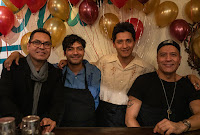
The best innovation of the movie is the twist in its latter half, when we meet the characters in their older incarnations; rather than using actors, all of the characters are simply portrayed at that point in the film by the real-life people themselves. It’s the perfect way for Ewing to balance the often dreamlike tone of the film’s first half and to allow these two men to claim their own story, as well as giving the audience a true opportunity to get to know them. (Also, it makes sense that the director would shift into documentary mode since her best-known previous films were documentaries.) Despite the acclaim that I Carry You with Me received at the Sundance Film Festival and at a few other awards ceremonies, it’s dispiriting that the movie earned under $200,000 at the box office upon its official mid-year release, which had been delayed by several months. Cinemas across much of the country were still just beginning to open up again at that point, and audiences were still somewhat wary of going to see movies in person at a movie theater, so clearly those factors were part of why few people have found the film. In an ideal world that would surely not be the case because this is an artfully rendered and deeply human movie that deserves to be widely seen.
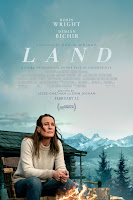
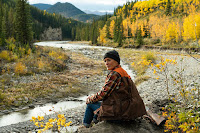
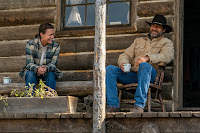
Robin Wright’s Land, her feature directorial debut, was actually one of the first films that I saw at a cinema up in Maine in 2021, way back in late February, just after a shutdown of several months had closed the cinemas there. I didn’t expect to be as emotionally affected by the movie as I was, probably due to a combination of the film’s subject matter, the circumstances in which I watched it by myself in the back row of an almost empty theater, and mainly seeing it at the time when I did, during the first winter of isolation and solitude at the worst point in the pandemic. Just as central to the movie’s power is Wright’s enduring performance as Edee, full of soul and gravity, which lasts for the entire length of the film. Even more impressive, perhaps, is how nearly all of the movie takes place at a single location, inside and around a small cabin high up in the wilderness of the Rocky Mountains in Wyoming (though the actual filming location was in Alberta, Canada).
Edee has retreated there from city life, determined to live in the mountains alone on her own terms, in spite of the difficult conditions and warnings from a local man who drives her up the mountain and hesitantly drops her off. Much to its advantage, the film doesn’t reveal the reason why Edee has fled her former life until almost the end of the film; she only mentions that she didn’t want to be around any other people. She experiences some peace in autumn and tries to grow more accustomed to living on the land. As the season turns brutal and her winter alone on the mountain takes serious hold, however, her situation indeed disintegrates rapidly from grim to desperate to catastrophic. On some level, we know that her plan for this to happen was semi-intentional, that she in fact no longer wanted to be alive, and yet she’s able to force herself to continue to survive by focusing on thoughts of her sister Emma, to whom she speaks early in the movie before going permanently off the grid.
Her character comes quite close to meeting a painfully gruesome and untimely end, and then she’s saved by a shy and kind-hearted local hunter named Miguel (played by the extraordinary Mexican actor Demián Bichir) and his caring but skeptical friend Alawa (Sarah Dawn Pledge), who’s a nurse in a nearby town. After Edee’s health gradually returns, Edee and Miguel become friendly over time and begin to open up to one another, with all the right notes of chemistry and trust between the actors, until Miguel eventually disappears from Edee’s life without notice or explanation. She soon persuades herself to try to track him down, once she’s feeling fortified enough to interact with other human beings again and face civilization. I typically resist movies that seem to pile on the heaviness, but where the film went next in briefly re-connecting Edee with Miguel made perfect sense to me, again an absolute testament to the strength of the acting. By the end, the movie becomes a study in grief and how we navigate it, share it, help each other survive it, and then if we’re lucky, how we attempt to emerge from the shadow of it and move on. Although the source of Edee’s grief is far more tragic than anything that I’ve ever lived through, I related instantly and intuitively to her feeling of being unable to persist anymore, and I felt inspired by how she finds a sense of resolve through her friendship with Miguel to gently push herself forward. Not many films have made me cry twice, but Land was one of them.
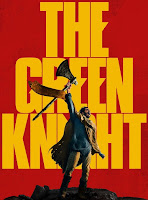
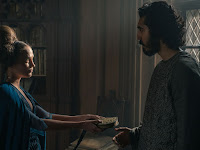
The Green Knight, based on the medieval English narrative poem about young Sir Gawain, is the latest film that I’ve loved by David Lowery, who’s among the best American filmmakers working today. As with his previous films A Ghost Story and The Old Man & the Gun, Lowery again constructs a picaresque adventure tale in a way that’s never really been presented before, handling the inherent slipperiness of time and the scope of humanity in relation to it with both inventiveness and a relaxed sensibility that embraces subtlety and abstraction. His relationship to the original tale of Sir Gawain is grounded enough for all the signposts of the legendary Arthurian romance to remain recognizable, yet he reimagines and expands on plenty of the details to place his own cinematic mark on the text. The casting of Dev Patel as Sir Gawain, certainly, puts a significant contemporary spin on Gawain’s journey to find the Green Chapel where the treelike and thick-trunked Green Knight (resonantly voiced by Ralph Ineson) lushly resides, after Gawain swiftly beheaded him as a challenge during a dinnertime tale-telling at his uncle King Arthur’s Christmas feast. The deal is that the Green Knight will then return the blow and strike Sir Gawain’s neck to behead him in exchange exactly one year later.
From the importance of honor to the enduring power of nature, the various literary meanings and interpretations linger as echoes throughout the movie, while Sir Gawain’s own legend spreads throughout the land and he becomes a kind of medieval celebrity whose quirky, youthful abandon makes him crush-worthy and enviable. Puppet shows pop up in towns across the countryside, where children crowd in to watch playful re-enactments of the Green Knight’s beheading and foreshadow the one that’s predicted to befall Sir Gawain in return. Along his winding quest to find the Green Chapel, Gawain encounters a skeleton at the crossroads swaying in a rusty iron cage, a band of punky thieves and swindlers who plunder his goods and leave him for dead, an ominous talking fox as his somewhat faithful guide and sidekick, naked giants who roam silently across the land, and a Gothic castle with a Lord (Joel Edgerton) and Lady (Alicia Vikander) who share a seductive interest in Sir Gawain that’s both platonic and sexual, prompting a rather special appearance of Gawain’s magical green cloth belt that gives him his trademark brand of mojo throughout the film. Vikander appears in two roles in the movie: as the mysterious Lady who heightens Sir Gawain’s erotic experiences on a new and more electric level, while having also portrayed his peasant lover Essel earlier in the film.
The style of the movie reminded me more authentically of the totally awesome ’80s adventure tales like Labyrinth and The Dark Crystal than any other movie I’ve seen since then, though scores of other films have attempted to approximate that winning formula and fallen short of achieving it. (Lowery has also professed to being a major fan of Ron Howard’s 1988 fantasy epic Willow.) But the detail-rich imagery and mesmerizing auras that Lowery evokes throughout The Green Knight are far more ambitious and maturely realized than any of its well-meaning predecessors. The payoff when Sir Gawain finally arrives to kneel before the Green Knight in the secluded oasis of his Green Chapel feels both knowingly subdued and grandly opulent. It’s a finale that takes its time with plenty of silence and a sense of dutiful purpose, before it segues via Sir Gawain’s momentary panic into one of the greatest “my life flashed before my eyes” sequences that’s ever been committed to film, as Gawain is plunged headlong into ruling his own kingdom and the ensuing waves of public chaos and familial tragedy and personal loss. How the movie allows Sir Gawain and the Green Knight to peacefully part ways and take their leave of one another aspires to a higher notion of storytelling. Rather than simply proclaiming Gawain’s honor for his courage and willingness to lay down his life as promised, the film’s ending also asks us what it means to let someone fulfill his own narrative mission, as well as what it means to have mercy on the brave and vulnerable who surround us.
Sunday, October 17, 2021
7th Annual GlobeDocs Film Festival (October 13th - 17th, 2021)
The return of the excellent GlobeDocs film festival here in Boston this past weekend found the Boston Globe’s annual documentary film festival in its seventh incarnation and its first “hybrid” year, with select films screening in person at the Coolidge Corner Theatre in Brookline and the Brattle in Harvard Square, as well as streaming virtually online, so that viewers could watch some additional films remotely at home. The three documentaries that I enjoyed most in this year’s festival are also the films that I’d most anticipated watching, and as always, the subject matter was rich and diverse: from tracing acclaimed pop singer/songwriter Alanis Morissette’s rise to stardom over 25 years ago in Jagged, to exploring the lives and works of celebrated LGBTQ comic book artists and graphic novelists in No Straight Lines: The Rise of Queer Comics, to movingly recreating via animation the turbulent immigrant journey of a young gay man from Afghanistan in the brilliant Flee.
I’d been curious to watch Alison Klayman’s Jagged ever since Alanis Morissette publicly denounced the film last month and somewhat distanced herself from its depiction of her life from her teenage years to the present, saying that she wouldn’t be appearing at any film festivals or release events in support of the documentary. Alanis is candidly interviewed in her home for a good portion of the movie, and I can imagine that such in-depth interviews do probably get fairly tiresome over time, especially when trying to articulate one’s personal views on such long-ago memories. Then when they’re shaped into a filmmaker’s own narrative, re-sequenced, and subjected to editing, often what the interview subject intended to convey can come across quite differently. Morissette mentioned that being interviewed during the pandemic after the birth of her third child also made it more difficult to feel emotionally steady throughout the filming.
This is especially true when the topic of Alanis’ early relationship experiences with older men who were involved in her career arises. She’s already handled that sensitive subject expertly in the lyrics of her own songs, both in one of her first runaway hits, “You Oughta Know,” and what I consider to be the finest song in her catalog, “Hands Clean.” While she makes a point of saying that she chose never to be vindictive in those songs or to publicly shame anyone in particular, she also looks back and realizes how vulnerable she was when she was still just a teenager. Those songs were intended as a clear warning to younger and underage women about the kinds of predatory dangers that seem to be dressed up in the guise of some romantic pursuits, and in a way, Morissette was a boldly prophetic figure of the #MeToo movement long before it existed as such. In part, this was an aspect of her music that helped shape her appeal to her core audience.
Jagged focuses mostly, however, on the album release and extensive worldwide tour for Jagged Little Pill back in the mid-’90s, and how exactly she became associated with her co-writer and producer Glen Ballard while landing a record deal with Madonna’s Maverick “boutique” label. We see plenty of archival footage of Alanis and the guys in her touring band back in those days. If there’s an aspect of her life that the documentary left me wanting to learn more about, it was her relationships, but for the reasons mentioned above, it’s also obvious why she would now be working diligently to keep those kinds of details about her life strictly private. The film does cover some of Morissette’s family life in her early years growing up in Canada, now perhaps juxtaposed with the shots of a savvy businesswoman speedily handwriting her way through boxes of special-edition autographed vinyl copies of Jagged Little Pill at her home before they’re shipped off to fans. Despite that distancing, the film does close with a very sweet rendition of her recent song “Ablaze” while she’s holding her young daughter and performing the song remotely for Jimmy Fallon’s late-night talk show. I was hoping to see more about that side of Alanis.
For its very different approach to a pop cultural rise into mainstream visibility, I found Vivian Kleiman’s No Straight Lines: The Rise of Queer Comics both informative and entertaining. I’ve always paid only peripheral attention to comics as an artistic medium, so the documentary was more of a learning experience for me at times. The film provides a consummate overview of the history of how LGBTQ comics gradually transformed from an underground, anti-censorship driven phenomenon in the wake of the Stonewall Riots into a widespread communal artistic enterprise in the ’80s and ’90s, and finally to gaining mainstream recognition through the event of a cultural touchstone like Alison’s Bechdel’s Fun Home (and its ensuing, Tony Award-winning musical stage adapation) over the past fifteen years or so. A wide array of cartoonists and graphic novelists are interviewed, both from a roster of older, more established comic book artists and a diverse line-up of younger emerging “next generation” LGBTQ figures as well.
I was particularly interested in seeing some of the inner processes of drawing and reproduction that go into making graphic novels, which the interviews with Alison Bechdel detail in fairly intricate fashion, showing elements of her hand-drawn style in close-ups while she’s working. Another figure who’s central to the documentary and whose work was fairly new to me was Howard Cruse. The founder and editor of the Gay Comix anthologies in the early ’80s, as well as his own well-known gay comics creation Wendel, he’s referred to in the documentary as “the godfather of gay comics” and sadly died quite recently near the end of 2019, when the documentary was in the process of being completed. He seemed to be an ongoing fixture in the LGBTQ comic book community that many of his contemporaries and younger artists sought out for advice about the business. We also see some moving domestic scenes of him and his longtime partner hanging out together at home in their older years, alongside corresponding images from a comic book that he created about older gay people who are often left out of the cultural LGBTQ discussion.
I’d heard wonderful things about Flee, Jonas Poher Rasmussen’s animated documentary about his friend Amin Nawabi, who grew up in Kabul as a boy, immigrated with his family to Russia to escape war-torn Afghanistan, and then eventually settled as an asylum-seeker in Denmark. Winner of the Documentary Jury Prize for World Cinema at Sundance, the film certainly lived up to all of its advance notice. In addition to rendering the director’s own extensive present-day retrospective interviews with Amin in a calm animated palette of (mostly) soft pastels, the movie reimagines Amin’s own earliest memories from 1984, when he’s running through the streets of Kabul with his Walkman and listening to the band A-ha’s notorious New Wave classic “Take on Me” in his earphones as a young child, up through roughly 1995, when he finally successfully flees from Moscow to Copenhagen as a teenager after a halting series of attempts to immigrate, harrowing setbacks in dark forests and on stormy oceans, and the various struggles and re-connections with his family. During his adolescence as he’s watching Jean-Claude van Damme action movies on television alongside his older brother, Amin also gradually begins to realize that he’s gay while gazing at the images of the muscular actor. Amin’s sexual identity is an important aspect of the film that underscores and highlights all of Amin’s other qualities and perceptions: his shyness, his melancholy, and his attentiveness, as he starts to grasp his own sense of outsiderdom on numerous levels.
Even in the context of animation, the documentary retains its sweeping narrative scope, yet we come to know Amin most closely through the moments of his smallest but most significant encounters and reminiscences. For instance, late in the film when he secretly flees toward Copenhagen as a refugee, he’s being covertly transported and smuggled in a vehicle with another young man, who’s slightly older than Amin, as his only fellow passenger. The two are talking quietly while lying down side-by-side on the floor of the truckbed so as not to be seen, and the other nameless youth notices that Amin is entranced by his gold necklace, which he then sweetly and generously gives to Amin as a gift just before they part ways to their two separate destinations at the airport. Amin laments that he never even found out the name of the other young man since Amin’s memory of him had such a profound and lasting effect on his life. Amin eventually goes to university, does post-doctoral work at Princeton, speaks at conferences about his experiences, and marries his husband Kasper in Denmark to settle down together in the countryside, when the animation on the screen briefly shifts to an actual shot of the trees and waterfront where they live. In the opening voiceover of the documentary, Amin equates home with safety, and it’s clear by the end of the film that he’s finally found both.
Sunday, August 8, 2021
Christina Pugh, Stardust Media (University of Massachusetts Press, 2020)
Christina Pugh’s fifth and latest collection of poetry, Stardust Media, is also for me her finest, though I could honestly say that about all of Pugh’s previous books, too, because fineness is the central quality that links her five volumes stylistically, at the level of attention, perception, and intelligence. Whenever I begin reading one of Christina’s books for the first time, I know that those properties are inherent from the start, so I never feel as if any grand proclamations about the work are even necessary since I know its character intuitively at the outset. I met Christina Pugh exactly twenty years ago now, when we taught a course together at Emerson College back in the spring of 2001, and I already admired Christina’s poetry at that point in time as well; therefore, I’m honored that we’ve remained close friends over the past two decades, through correspondence, phone conversations, and in-person reunions, mostly for dinners, poetry readings, and visits to the cinema. (I use the word “close” intentionally, in part because I consider Christina to be a true practitioner of the art of closeness. These days, that art is increasingly rare.) Our friendship has persisted across distances and weathered the changes and upheavals that we’ve witnessed both nationally and globally throughout that span of time. Only a few months after we taught our course together, the events of 9/11 transpired when Christina was living and teaching on Staten Island, and in a certain sense, it feels like that was the incipient moment of everything we’ve all endured culturally since then. As Christina writes at the end of “My Twenty-First Century,” the poem that opens Stardust Media, “When the towers blazed, / I’d stood on the shoreline, seared as I had ever / Been, and carefully watched that smoke cross the water.”
Awarded the prestigious Juniper Prize from the University of Massachusetts Press in Amherst, Stardust Media was released in April of 2020, right after the world had initially shut down for our ongoing Covid-19 pandemic. After living through the past year and a half of intermittent lockdowns and quarantines, vaccinations and their days of after-effects, continually exhausting news cycles, and widespread social interiority as we all retreated into our own private spaces, the deeply insightful poems in Stardust Media now make me feel like it’s a prophetic book. Thematically, Pugh’s focus throughout the collection fixates on our contemporary networks and technologies, the various forms of social and visual media that connect and separate us simultaneously. Her stance is equally one of openness and resistance to the types of sweeping changes that those technologies have brought to our culture and to the art that we create; the poems are both engaged critiques and participatory observations. Pugh does not exempt herself from our digital landscape, which would be the easy decision for a poet to make. Rather, she endorses and questions earnestly her own place within it, which doesn’t mean, of course, that her own position is always comfortable. When one of the poems in the book is titled “I Don’t Know How to Make a Website,” we know the sort of interrogative and self-reflective territory that we’re in.
That particular poem, actually, is one I’ve kept returning to, mainly for its direct association with Robert Frost’s brilliant sonnet “Design.” Pugh’s poem counterpoints “website” with “web-sight,” and a contemplation of spiders and the secret hazy cobwebs they spin opens the connection to the “dimpled spider, fat and white,” holding up a moth on a white heal-all in Frost’s poem, an image that encouraged Frost to wonder about the origins of its symbolism in one of his greatest questions: “What but design of darkness to appall? — / If design govern in a thing so small.” Pugh’s own response couldn’t be any richer: “An if around design, that / white heal-all, keeps haloing the web-sight.” It’s a perfect metaphor for Pugh’s poetry itself, a kind of literally intricate web-weaving, suspended up in a tucked away corner for those who seek it out, softening the angles of the room, gauzing our gaze as we sharpen our vision to see it more clearly, in order to match Pugh’s artful vision. She guides her readers to that point and trusts them from there.
Perhaps that’s why, a little bit later in the book, Pugh tells us straightforwardly that “Frost would have junked the telescope.” As much as she looks outward (at nature and art, at color and light, at shape and texture), she’s essentially an inward-looking writer, a poet of complex human nuances and details. “I love my life in a nautilus shell,” she writes in one poem, plainly and revealingly. That’s not to say I would ever situate her with the people of our current younger generation who’ve tunneled and burrowed so far inward via social media. Pugh’s book is titled Stardust Media for a reason, instead of some other brand of more familiar or less evocative media. The collection’s title poem, which takes its epigraph from Cocteau Twins’ vocalist Elizabeth Fraser, pushes toward the boundaries of the transcendent that we most often find through music, and certainly through the Cocteau Twins’ songs that devise their own language; “the Sirens would have / never sung in words — so their semitones / unspooled the way that bodies pool and crash / together, raptured after sex.” Other well-known musicians appear throughout the book, from the realms of pop, folk, blues, and alternative rock: Kurt Cobain, Gram Parsons, Emmylou Harris, Charley Patton, Steely Dan, and most transfixingly, in a sequel to the book’s title poem, Ian Curtis of Joy Division (“he reached for / a magnetic field from far within that foaming [. . .] // place a stone inside / the music”). Together, they all provide a sort of under-voice for the collection, or maybe they even loosely cohere as a disparate chorus of the underworld, an inverted heaven that the book’s title again seems to suggest.
If those aural spirits provide Stardust Media with its haunting soundtrack, then the volume’s plethora of visuals construct for us its endless chain of glowing screens of every size, our handheld devices and laptops with their luminescent wallpaper. Early in the collection, “Smartphone Inlet” presages that trend through a deft comparison of embroidery to texting, reaching back for contrast through history to eras when “women / would brood like robins on inchoate / letters pulled airily from cloth,” but whose “words were never / lit from within, the way that ours are.” Pugh dances back and forth from the clack and chime of a manual typewriter’s carriage in “Toll,” to stolid Ohio barns along the interstate highway (“Sky-blue / with white roofs. Wait, isn’t sky-blue brighter / than any sky you really see?”), to a meditation on Krzysztof Kieslowski’s cinematic masterpiece Blue, to “the promiscuity of television,” naturally, “its screen, I mean, since it flickers to anyone.” And so our present-day technologies are met in Pugh’s poems, ultimately, with a democratizing embrace, although more tangible physical artifacts also maintain their foothold: Italian Renaissance art, handcrafted lace, Luigi Ghirri’s photographs, James Turrell’s geometrical lightscape installations, the spotlit set design accompanying a stage production of David Lang’s composition “Where you go,” which inspires a moving dedication to Pugh’s husband, Richard DelVisco (alongside echoes of another major theme of the book, the recent death of Christina’s father).
One exciting aspect of the book for me was reading a poem about a musical performance that I attended myself with Christina and Rick when I was visiting their city of Chicago back in November of 2015. It’s actually the very first time that I’ve ever “seen” myself in a poem in exactly this way, and that makes it quite special to me. During my visit, we went to watch a concert at City Winery by the singer/songwriter Susan Werner, which prompted Pugh’s poem “Pink, Pink, Pink,” particularly Werner’s choice of song for her encore that evening (“we heard an Iowan / sing La vie en rose with, to my ear, no American accent. / And I was listening hard for a caving of the r”). The concert happened on the same night in 2015, Friday, November 13th, when several coordinated terrorist attacks in Paris, France, killed 130 people and injured hundreds more. Due to the timing of our pre-show dinner and the concert itself, we weren’t aware of this tragic news until just after the show had ended: “When she sang, / I hadn’t yet heard about the murders in France / or seen our own monuments lit blue, white, / red and American ambidextrous. But nobody / says rose-colored glasses anymore.” In this poem, and throughout Stardust Media, Christina Pugh amply captures the world at its own pace, on the brink of where we all now currently stand.
Saturday, July 10, 2021
Robert Hamberger, Blue Wallpaper (Waterloo Press, 2019)
I remember meeting the wonderful English poet Robert Hamberger (through our mutual friend, the equally wonderful English poet John McCullough) about a decade ago now where he lives in Brighton on the southern coast of England. When I asked Robert the title of his latest collection of poetry that he was working on at the time and he said, “Blue Wallpaper,” I thought it was one of the best book titles I’d heard in a long while. The book came out several months prior to the Covid-19 pandemic, and now that our international mail delivery is finally back to normal here in the United States, I was very happy to receive Robert’s book in the mail just a few days ago, after looking forward to reading it ever since that time we met in Brighton.
The poems and themes in the book are beautifully consistent with those in his three previous volumes, and having now read through Blue Wallpaper twice, I’m more convinced than ever of Robert Hamberger’s permanent place in the canon of English poetry. His mastery of the sonnet and other poetic forms, along with his limber command of the line in free verse as well, should secure his position in a literary lineage that makes me think of the great World War I poets Wilfred Owen, Rupert Brooke, and Siegfried Sassoon, and perhaps especially Edward Thomas, who crafted some of the most perfect formalist poetry in the English language. In the case of many of those poets, love between men is frequently central, as it is in Hamberger’s writing, too.
Blue Wallpaper opens with “The lesson of sand,” one of six subtitled sections that give the volume its intricate structural solidity. The seven sonnets in this first section of the book are elegies in remembrance of Hamberger’s mother, both in her younger years when she resembled a glamourous Ingrid Bergman in Casablanca, and in her later years struggling with aging and memory loss, when Hamberger would visit her regularly at a care home: “I stay for an hour, watching the lesson / of sand giving way again to sea.” It’s a precise and careful metaphor that encompasses so much: time as it slips away from us, our delicate human relationships under the power of something greater, yet also bearing witness to the traces of our lives that still remain after the waves have washed over us and receded again.
Similarly, in the book’s wistful second section, “Coming home,” Hamberger reflects back on his family relationships from his youth, etching an indelible boyhood memory of a lost brown jumper with a yellow camel on it, which his mother had knitted for him before his father “went / the way of camels and palm trees.” Hamberger is always adept at lifting these sorts of tokens of memory back up into the light and showing them to us in their vivid and moving resonances: listening to “Dancing in the Street” by Martha and the Vandellas up in his bedroom as his mother shouts for him to turn the music down, memorializing an injured war veteran and “cloth-cap tenor” who would serenade for coins in the streets of their neighborhood, and detailing an older gay man with a “citrus scent / he must have sprayed at his wrists and throat” who chatted him up during the intermission at a screening of The Sound of Music before Hamberger’s mother ushered him back to their seats. One of my favorite poems in the book, “Mr Muxworthy,” gorgeously recalls Hamberger’s schoolboy crush on a handsome teacher who “peeled off his shirt in front of us / that time before gym, baring his hairy chest, / its tangled fascination, elbowing himself / into maroon and yellow stripes, / ready to shout at us to run and run.” Then the poem pivots towards darkness as Hamberger imagines climbing inside the man himself, to “tunnel to the trees barred by his ribcage, / stroke the smoky branches there.”
The fabulous third section in the middle of the book collects seven sonnets by Arthur Rimbaud, adapted by Hamberger from literal translations by his husband Keith Rainger, ranging in subject matter from the leaner socioeconomic life of poets in “My Bohemia,” to a colorful meditation on the vowels of the alphabet, to the hilarious “Arsehole sonnet” that pays riotous tribute to that particular part of the human anatomy. I was reminded on several levels of Robert Lowell’s 1961 book Imitations, his terrific collection of loose translations and re-imaginings of poems by a wide array of famous European writers throughout history, which included several renderings of poems by Arthur Rimbaud as well. The powerful fourth section of Blue Wallpaper, “Golden dragon,” turns to poems about mythical and natural creatures of various kinds: a kestrel spotted out on the patio (“that head a claw-hammer”) making a meticulously violent meal out of a fledgling starling, a lobster wielded on a silver platter in a restaurant “like an armoured warrior” (with deft echoes of Elizabeth Bishop’s warrior in her poem “The Fish”), right down to the very last fly of winter “uselessly fussing against glass.”
“Husbands,” the book’s fifth section, features a wide and attentive array of love poems. I was riveted (and also reminded of legendary gay performance artist Leigh Bowery) by the tender scrutiny of Hamberger’s poem “Becoming a Lucian Freud nude,” a semi-self portrait of an aging male body seen in a long bathroom mirror: “Blotches, moles and blemishes / map my years / in coral, oyster, pink,” and yet because every sign of age is also evidence of survival, Hamberger rightly proclaims by the poem’s end, “Victory’s here.” The final section of the book, “Being the sea,” re-traces Hamberger’s move to Brighton, where he settled after a series of major life changes recounted in his previous collections. The contemplative “Unpacking the books” locates Hamberger’s place on the bookshelf amongst the poets he admires, while “35C” maps the interior of his living space in relation to the world outside of it. “The AIDS memorial,” one of the finest poems to arise from the aftermath of the HIV/AIDS epidemic, remembers twenty years after their deaths Hamberger’s close friends, the artist Clifford Haseldine (one of whose paintings appears on the book’s cover) and Clifford’s partner Andrew: “Tonight your names / join a list at the service. / Couples and singles cup their flames / by this floodlit memorial. / Once I’m numb from too much snow / I’ll kneel before the sea’s crashed gardenias.” The title poem of Blue Wallpaper, which closes the volume, envisions the poet himself poised again at the edge of the sky and the ocean where “I’m here and a hundred miles away; / this morning and fifty years ago / roll together.”
That’s actually the aspect of Hamberger’s body of work that I always enjoy the most, how he’s able to navigate time in a way that situates the present and the past not only in relation to one another, but also side-by-side in a kind of stunning lapidary manner. I think it’s one of the most important mysteries of our shared predicament as human beings, as we move together through our allotment of years on the planet; we continue to accrue new memories with each day that passes, even though our memories from the days that have already passed continually swim back, then fade away, and then swim back to us again.
Sunday, June 20, 2021
23rd Annual Provincetown International Film Festival (June 16th - 25th, 2021)
The film festival in Provincetown made a gradual post-pandemic return this past week, with Waters Edge Cinema hosting the majority of the screenings. I watched four films there over the past several days, as well as one at the Mary Heaton Vorse House in town, in addition to streaming some of the festival selections online. While it felt quite different from my routine at the festival in previous years, when I’d watch as many as twenty movies at the venues around town over five days, it was also nice to ease my way back into things this year because it’s been quite a long time since I’ve sat shoulder-to-shoulder with other moviegoers at a cinema, given the restrictions during the various lockdowns internationally throughout the past year and a half. Of course, that made it even more fun to see the five in-person screenings that I was able to attend at this year’s festival, so here are the details on my four favorite films that I watched.
I’d really been looking forward to seeing Summer of 85, the latest film from gay French director François Ozon, who’s long been one of my favorite filmmakers. The movie was just about as enjoyable as I’d anticipated, and well in line with the themes and tones of Ozon’s previous movies. A unique hybrid of a gay teenage love story and a darker-edged thriller, Summer of 85 is loosely adapted from Aidan Chambers’ 1982 young adult novel Dance on My Grave, and I could definitely feel the tendons of that particular source material connected to the movie at various points while watching it, especially in the adorably innocent scenes of Alex (Félix Lefebvre) and David (Benjamin Voisin) falling for one another and exploring the intensity of their physical attraction. Of course, the characters are somewhat too young and fresh-faced even to know what to do with that attraction to a certain degree, and so Alex becomes instantly jealous when David’s attentions suddenly turn instead to a young woman named Kate (Philippine Velge), whom the two boys have recently befriended.
And that’s where the storyline clearly takes a turn toward the tragic. Some critics have remarked on the clashing tones of a film that swerves from a fun and sunny gay teenage love story to a somber tale of heartbreak and loss, but having watched many of Ozon’s films numerous times, I saw plenty of worthwhile consistencies and linkages with his other movies and therefore understood why he’d have been interested in adapting Chambers’ novel for the screen in the first place. My two favorite films by Ozon, Time to Leave and Le Refuge (Hideaway), explore the difficulties, disappointments, and sustaining qualities of sexual and emotional relationships. Ozon always pursues those complexities ardently, rather than simply letting his films remain in an overly comfortable zone for his longtime viewers. Although the moments of discomfort in Summer of 85 can feel a bit too overt at times, and its plot twists a little too blunt, the actors all sustain the audience’s interest and make feeling concerned about these characters a rewarding endeavor, ultimately, even if invoking Luca Guadagnino’s Call Me by Your Name was excessive, given my views of the shortcomings of that over-praised film.
If there’s any movie that could resurrect Vivante hair products overnight, it’s Todd Stephens’ gorgeous new dramedy-meets-road movie Swan Song, starring the legendary Udo Kier in what will probably be remembered as his best performance eventually, if there’s any justice in the cinematic universe. I’m a lifelong fan of Todd Stephens’ 1998 classic Edge of Seventeen, mainly because I came of age in Ohio in the ’80s and found his rendering of what it was like to grow up as a gay man in the Midwest back then to be so precise that characters in Edge of Seventeen matched up exactly with some of the people I knew back in my own youth. Swan Song situates its comedic and dramatic concerns at the other end of the age spectrum with Kier’s portrayal of retired hairdresser Pat Pitsenbarger, who’s unexpectedly called upon to perfect one final hairdo for his former client, the wealthy socialite Rita Parker Sloan (Linda Evans of Dynasty, totally fabulous), after she’s passed away. It’s the woman’s dying wish, which her gay grandson Dustin (Michael Urie) has helped to actualize for her. Jennifer Coolidge also makes a memorable and semi-villainous appearance as Dee Dee Dale, Pat’s haughtier-than-thou hairdressing nemesis.
So Pat sets off on a journey through rural Ohio on foot, hitching a ride or two along the way, to return to Sandusky on the northern border of the state along Lake Erie, where he’d previously owned a hair salon and lived with his partner David, who sadly died of AIDS back in the mid-’90s. Throughout Pat’s picaresque trek, he re-encounters ghosts of various kinds from his past, some of whom are figments of his imagination, culminating in an unforgettable performance at a gay nightclub, one that quite openly owes a debt to The Adventures of Priscilla, Queen of the Desert and Terence Stamp’s seminal Oscar-nominated role in it. For many of the above reasons, I knew that I’d enjoy Swan Song even before watching it, but I was moved over and over again in ways that I hadn’t anticipated, mostly due to Udo Kier’s soulful and uninhibited embodiment of his character, with his famous ice-blue eyes and flamboyant gestures sweeping viewers along through every scene, while also conveying quiet depths of feeling in his long and distinguished career’s crowning achievement.
Halfway through watching Daniel Sánchez López’s Boy Meets Boy, I realized that I’d been smiling widely the entire time. Inspired by the likes of Andrew Haigh’s 2011 film Weekend, the story of Boy Meets Boy is simply the chance meeting of two 20-something gay guys, a dancer named Johannes (Alexandros Koutsoulis) and a doctor named Harry (Matthew James Morrison), who walk together around Berlin and talk (and flirt, and have sex with each other) over the course of a long day, after they bump into each other and make out on the dance floor at a club. Johannes then takes Harry to a late-’90s style internet café, so that Harry can print out his boarding pass for his flight back home to the U.K. What had me smiling for 45 minutes straight was how the camera usually focuses on the two guys and nothing else, which heightens their immediate intimacy for viewers. For example, at the internet café, when they take turns drawing images of each other using the old-school graphics program called Paint, we never even glimpse the computer or its screen at all, only their sweet and beaming faces, mutually happy that they’ve found someone whom they’re interested in, and someone who reciprocates that interest.
The film made me aware of something that I’d never before considered about gay relationships. They’re often quick and brief in my experience, in part because in the initial moments and hours of getting to know somebody, we’re allowed to imagine them as we hope they’ll turn out to be. Long-term relationships are rarer, of course, because the more fully we get to know somebody over time, the more we become certain about who they actually are, so then the exhilarating rush of imagining them as we hoped they’d be gradually recedes and settles into more mundane, realistic routines. While some people may find the chattiness of Boy Meets Boy boring or derivative, I felt the opposite. Gay men have received somewhat of a raw bargain in terms of how we’ve been represented on screen, historically, so I personally think that we can never have too many “naturalized” renderings of gay relationships on screen. The more stories I see about gay men who are just being themselves and living their everyday lives, the better.
I was so moved by Nora Burns’ David’s Friend, her hour-long theatrical show with the awesome Billy Hough, directed for the stage by Adrienne Truscott, and filmed for the screen by documentarians (and real-life couple) David Ebersole and Todd Hughes. Fortunately, Burns’ live performance of the show was recorded in Los Angeles on March 8th, 2020, just one week before the worldwide lockdown due to the global Covid-19 pandemic. Burns’ play, exquisitely written and performed with equal amounts of fierceness and tenderness, captures perhaps the most important period in our recent pop cultural history, from the time in 1979 when Burns met her close gay friend David while dancing at the long-defunct gay club at 1270 Boylston Street in Boston (“I went right from Donny Osmond to Donna Summer,” Burns recalls, “there was no AC/DC in between”), through their years in New York tearing up the city with wild scenes of sex, drugs, and hustling, right up until David’s early death from AIDS in 1993. Photo projections from throughout their friendship punctuate Nora’s monologue, as do flashback entries from Burns’ long-ago journals, along with notes and letters written from David to Nora, in which he professes his heartfelt (and occasionally drug-induced) feelings of total love for her, moments that made me cry twice in the span of Burns’ show.
Although Nora and David were most interested in simply enjoying their youth and living their lives to the hilt at a time when the world was still so full of possibility and interconnected in real-time (rather than through the mediation of devices and screens), they also made their mark on an urban art scene that would gain genuine nostalgic currency from then to now. Not only did they celebrate at legendary venues like Studio 54 and pretty much every single gay bar in Manhattan, turning up in the famous club photos of New York photographer Patrick McMullan, but David was also well-connected and admired (and gorgeous) enough to be hand-drawn by the likes of Tom of Finland. The lingering cultural PTSD in the aftermath of the AIDS crisis haunts the show and Burns’ own delivery of her monologue, when her eyes well up with tears several times as she recounts and conveys the tragic early loss of her close friend. What she and co-star Billy Hough, along with the stage director and filmmakers, have accomplished in David’s Friend is that they’ve now given Nora’s collected memories of David the chance to live again and be preserved forever.
One aspect of the Provincetown Film Festival that I always love best is how it makes me feel like LGBTQ+ life stories, and particularly those of gay men, really matter and still have a significant place in our ongoing social discourse. As the world has continued to progress and change in profound and crucial ways over these past several years of remarkable cultural upheavals and political action, I’ve sometimes wondered how much our collective experiences as gay men have spoken to people inside and outside of our own community. The artistic and communal events at the annual film festival in Provincetown help to promote and fortify a world and a future where those stories will continue to matter in shaping society and our own directions within it throughout the coming decades.
Subscribe to:
Posts (Atom)


