With the pandemic continuing throughout 2021, it was another highly unusual year for cinema, as movie theaters here in New England faced lengthy (and often quite sudden) shutdowns and hesitant re-openings as public health parameters shifted locally and globally. Some cinemas and theater chains didn’t survive those changes and the subsequent loss of film audiences when more people retreated to streaming films online at home. Somehow, I was able to keep myself going to see movies in person at cinemas throughout nearly the entire year, though the rollout of worthwhile new films was slow and halting, as film companies carefully measured and re-calibrated what might be worth releasing and when. Release schedules continued to get jostled around as film releases were postponed and timed for when they might get the best kind of audience response at the box office. Therefore, as with my year-end post for 2020, just three movies lingered with me most throughout 2021, and in each case, I was drawn to them as much for their subtle emotional pull as for their narrative and visual craft. I felt like these movies spoke to my own levels of sadness at the ongoing state of the world and offered some consolation and distant yet intimate company via their artistry.
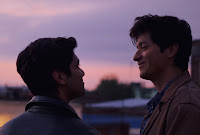
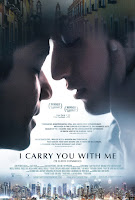
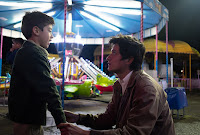
It’s fitting that Heidi Ewing’s moving and relatively little-seen gay Mexican immigrant romantic saga I Carry You with Me was my favorite movie in a year when Jane Campion’s much-lauded, quasi-gay Western tragic epic The Power of the Dog could win Best Picture (and Best Director) at the Oscars. While Campion’s novel-like film is certainly finely made, intricately deployed, and superbly acted, its mystifying effect on the mostly straight audience that I saw it with seemed to be its intended goal, whereas a gay male viewer like me could easily see the planted curveballs coming. I Carry You with Me has fewer tricks up its sleeve, perhaps because it wears its heart more openly there, which isn’t to say that it’s a simple story, nor one that’s simply conceived. Based on the actual relationship of two of Ewing’s gay friends, Iván (Armando Espitia) and Gerardo (Christian Vásquez), a chef and a teacher, respectively, the film follows the two young men from their initial meeting at a club in Puebla, Mexico in the ’80s through their struggles to immigrate to New York City, to nearly the present day and their celebration of their time together running a restaurant there. I was engrossed in their story and right with them every step of the way, and the immigration scenes especially were some of most powerful I’ve seen on film. Their romance is equally well-developed and sincere, at a time when more movies still need that sort of earnest depiction of gay male characters.
Drama and hardship aren’t left out of the picture, of course, since Iván is a closeted and married father of a young son when he and Gerardo first meet, and both face intense and overt familial homophobia during their youth and upbringings. Machismo and the masculine pressure to conform in erasing any form of effeminacy in boys runs rampant throughout the culture, one in which fathers like Gerardo’s and Iván’s are pressured to punish and cruelly abandon their own young sons for the boys’ inability to meet their society’s unfair masculine standards. For that reason, it’s also quite uplifting and reaffirming to watch a gay film in which the characters can all transcend those hardships and eventually overcome their obstacles to actualize their dreams. The moment when Iván’s chance at fulfilling his ambitions finally arrives by happenstance in the kitchen of a Manhattan restaurant was perhaps the most moved I felt at the cinema this past year.
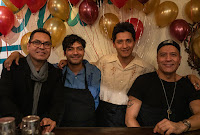
The best innovation of the movie is the twist in its latter half, when we meet the characters in their older incarnations; rather than using actors, all of the characters are simply portrayed at that point in the film by the real-life people themselves. It’s the perfect way for Ewing to balance the often dreamlike tone of the film’s first half and to allow these two men to claim their own story, as well as giving the audience a true opportunity to get to know them. (Also, it makes sense that the director would shift into documentary mode since her best-known previous films were documentaries.) Despite the acclaim that I Carry You with Me received at the Sundance Film Festival and at a few other awards ceremonies, it’s dispiriting that the movie earned under $200,000 at the box office upon its official mid-year release, which had been delayed by several months. Cinemas across much of the country were still just beginning to open up again at that point, and audiences were still somewhat wary of going to see movies in person at a movie theater, so clearly those factors were part of why few people have found the film. In an ideal world that would surely not be the case because this is an artfully rendered and deeply human movie that deserves to be widely seen.
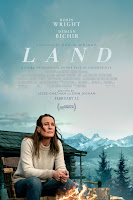
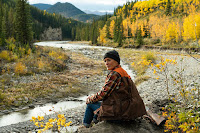
Robin Wright’s Land, her feature directorial debut, was actually one of the first films that I saw at a cinema up in Maine in 2021, way back in late February, just after a shutdown of several months had closed the cinemas there. I didn’t expect to be as emotionally affected by the movie as I was, probably due to a combination of the film’s subject matter, the circumstances in which I watched it by myself in the back row of an almost empty theater, and mainly seeing it at the time when I did, during the first winter of isolation and solitude at the worst point in the pandemic. Just as central to the movie’s power is Wright’s enduring performance as Edee, full of soul and gravity, which lasts for the entire length of the film. Even more impressive, perhaps, is how nearly all of the movie takes place at a single location, inside and around a small cabin high up in the wilderness of the Rocky Mountains in Wyoming (though the actual filming location was in Alberta, Canada).
Edee has retreated there from city life, determined to live in the mountains alone on her own terms, in spite of the difficult conditions and warnings from a local man who drives her up the mountain and hesitantly drops her off. Much to its advantage, the film doesn’t reveal the reason why Edee has fled her former life until almost the end of the film; she only mentions that she didn’t want to be around any other people. She experiences some peace in autumn and tries to grow more accustomed to living on the land. As the season turns brutal and her winter alone on the mountain takes serious hold, however, her situation indeed disintegrates rapidly from grim to desperate to catastrophic. On some level, we know that her plan for this to happen was semi-intentional, that she in fact no longer wanted to be alive, and yet she’s able to force herself to continue to survive by focusing on thoughts of her sister Emma, to whom she speaks early in the movie before going permanently off the grid.
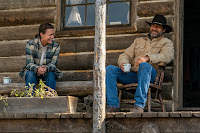
Her character comes quite close to meeting a painfully gruesome and untimely end, and then she’s saved by a shy and kind-hearted local hunter named Miguel (played by the extraordinary Mexican actor Demián Bichir) and his caring but skeptical friend Alawa (Sarah Dawn Pledge), who’s a nurse in a nearby town. After Edee’s health gradually returns, Edee and Miguel become friendly over time and begin to open up to one another, with all the right notes of chemistry and trust between the actors, until Miguel eventually disappears from Edee’s life without notice or explanation. She soon persuades herself to try to track him down, once she’s feeling fortified enough to interact with other human beings again and face civilization. I typically resist movies that seem to pile on the heaviness, but where the film went next in briefly re-connecting Edee with Miguel made perfect sense to me, again an absolute testament to the strength of the acting. By the end, the movie becomes a study in grief and how we navigate it, share it, help each other survive it, and then if we’re lucky, how we attempt to emerge from the shadow of it and move on. Although the source of Edee’s grief is far more tragic than anything that I’ve ever lived through, I related instantly and intuitively to her feeling of being unable to persist anymore, and I felt inspired by how she finds a sense of resolve through her friendship with Miguel to gently push herself forward. Not many films have made me cry twice, but Land was one of them.
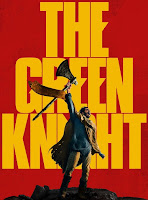
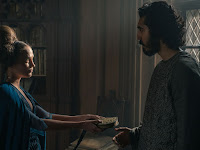
The Green Knight, based on the medieval English narrative poem about young Sir Gawain, is the latest film that I’ve loved by David Lowery, who’s among the best American filmmakers working today. As with his previous films A Ghost Story and The Old Man & the Gun, Lowery again constructs a picaresque adventure tale in a way that’s never really been presented before, handling the inherent slipperiness of time and the scope of humanity in relation to it with both inventiveness and a relaxed sensibility that embraces subtlety and abstraction. His relationship to the original tale of Sir Gawain is grounded enough for all the signposts of the legendary Arthurian romance to remain recognizable, yet he reimagines and expands on plenty of the details to place his own cinematic mark on the text. The casting of Dev Patel as Sir Gawain, certainly, puts a significant contemporary spin on Gawain’s journey to find the Green Chapel where the treelike and thick-trunked Green Knight (resonantly voiced by Ralph Ineson) lushly resides, after Gawain swiftly beheaded him as a challenge during a dinnertime tale-telling at his uncle King Arthur’s Christmas feast. The deal is that the Green Knight will then return the blow and strike Sir Gawain’s neck to behead him in exchange exactly one year later.
From the importance of honor to the enduring power of nature, the various literary meanings and interpretations linger as echoes throughout the movie, while Sir Gawain’s own legend spreads throughout the land and he becomes a kind of medieval celebrity whose quirky, youthful abandon makes him crush-worthy and enviable. Puppet shows pop up in towns across the countryside, where children crowd in to watch playful re-enactments of the Green Knight’s beheading and foreshadow the one that’s predicted to befall Sir Gawain in return. Along his winding quest to find the Green Chapel, Gawain encounters a skeleton at the crossroads swaying in a rusty iron cage, a band of punky thieves and swindlers who plunder his goods and leave him for dead, an ominous talking fox as his somewhat faithful guide and sidekick, naked giants who roam silently across the land, and a Gothic castle with a Lord (Joel Edgerton) and Lady (Alicia Vikander) who share a seductive interest in Sir Gawain that’s both platonic and sexual, prompting a rather special appearance of Gawain’s magical green cloth belt that gives him his trademark brand of mojo throughout the film. Vikander appears in two roles in the movie: as the mysterious Lady who heightens Sir Gawain’s erotic experiences on a new and more electric level, while having also portrayed his peasant lover Essel earlier in the film.
The style of the movie reminded me more authentically of the totally awesome ’80s adventure tales like Labyrinth and The Dark Crystal than any other movie I’ve seen since then, though scores of other films have attempted to approximate that winning formula and fallen short of achieving it. (Lowery has also professed to being a major fan of Ron Howard’s 1988 fantasy epic Willow.) But the detail-rich imagery and mesmerizing auras that Lowery evokes throughout The Green Knight are far more ambitious and maturely realized than any of its well-meaning predecessors. The payoff when Sir Gawain finally arrives to kneel before the Green Knight in the secluded oasis of his Green Chapel feels both knowingly subdued and grandly opulent. It’s a finale that takes its time with plenty of silence and a sense of dutiful purpose, before it segues via Sir Gawain’s momentary panic into one of the greatest “my life flashed before my eyes” sequences that’s ever been committed to film, as Gawain is plunged headlong into ruling his own kingdom and the ensuing waves of public chaos and familial tragedy and personal loss. How the movie allows Sir Gawain and the Green Knight to peacefully part ways and take their leave of one another aspires to a higher notion of storytelling. Rather than simply proclaiming Gawain’s honor for his courage and willingness to lay down his life as promised, the film’s ending also asks us what it means to let someone fulfill his own narrative mission, as well as what it means to have mercy on the brave and vulnerable who surround us.
Monday, January 1, 2018
Five Favorite Films of 2017
As popular cinema grew ever more mainstream and dominant throughout 2017, in a year when even the political realm became more corporate and corrupt (who thought that could be possible?), the small arthouse films that appealed to me the most also got riskier and more ambitious than usual. When the artistic stakes are higher, it makes sense that this type of counter-balancing would take place, a kind of aesthetic resistance and survival instinct, which is also a refusal to give in to market demands, saying that artful movies aren’t going anywhere, and saying it more demonstratively and provocatively than in prior years.
David Lowery’s A Ghost Story lingered with me longer than any other movie that I saw in 2017. Even while I was watching it at the cinema, I knew that would be the case. Framed in a square with rounded corners in the center of the screen, to evoke the look of old printed snapshots from photo albums, the movie is a valentine to the idea of time, as well as a bold and resonant excavation of the meaning of time. On its quiet and undisturbed surface, it’s a story of grief, and one that many people who chose not to see the film thought was driven by a gimmick. A ghost under a flowing white sheet with eye-holes cut out of it haunts the home that Casey Affleck’s unnamed character shares with Rooney Mara’s unnamed character after Affleck’s character dies in a car crash early in the film.
Long, silent scenes in which the camera doesn’t move at all set up the action of the tale, as it were. The body of Affleck’s character, seen from a distance across the room, lying under a white sheet at the hospital. Mara’s grief-stricken character, sitting alone on the floor of their dark kitchen, methodically devouring an entire pie over several minutes. These scenes are not meant to try the viewer’s patience, but to put us in the characters’ mindset, and to begin to ask what it means for minutes, hours, days, and years to pass, both in the presence of others and in the absence of others. And an image that might seem sentimental elsewhere — the ghost repeatedly attempting to scratch open a painted-over crack in a wooden doorframe, in which Mara’s character has slipped a secret note — felt perfectly logical and moving to me.
When the succession of humans isn’t in the house, the ghost is never alone for too long. It can see another ghost in a similar predicament in the house across the way, and the two ghosts can even communicate with one another, at least for the audience’s purposes. Because this is a film that’s better to watch knowing less than more, I’ll leave the movie’s other rich details and innovations unexplained, except to mention that the film’s ambitions deepen and quicken when the entire movie pivots and the ghost cascades through time and space, only for time and space to loop back on themselves until the experience of the film circles into a seamless whole and vanishes all at once. Few films work on poetic association and pull it off, but this one does.
God’s Own Country, a British debut directed by Francis Lee, was the best gay-themed movie that I watched over this past year, and not just because everything turns out fine for the two central characters in the end. Set in the austere and rolling hills of Yorkshire, it’s the first gay movie since Alain Guiraudie’s Stranger by the Lake that’s so fully formed by its immersive landscape and atmosphere. The story follows Johnny Saxby (Josh O’Connor), who’s become increasingly withdrawn and dissatisfied from living and feeling entrapped on his family’s remote sheep farm. A fast and discreet encounter with another young man after a livestock auction near the start of the film shows that Johnny’s not comfortable with anything more than casual sex, though a conversation with a female friend of Johnny’s outside of a pub also suggests that he has been somewhat openly gay, if also obviously self-stunted by his rural environment.
The appearance of Gheorghe (Alec Secareanu), a young Romanian man who comes to help out on Johnny’s farm, gradually changes all of that, and the film draws its intimate power from the slow dance of attraction in which the two men become entangled. It’s impossible not to compare the film to Brokeback Mountain, of course, and God’s Own Country alludes directly to its predecessor not only thorough sheep-herding, but also via articles of the men’s clothing that are shared and left behind. In a film whose dialogue is often spare, subtle and precise symbols convey more readily what the two men are feeling: repairing a stone wall together that they nonetheless remain on opposite sides of, an abandoned sweater that Johnny pulls over himself, echoing a riveting earlier scene in which Gheorghe protects a tiny lamb in a way that nudges harshness into tenderness. While I felt the screenplay ran out of road a bit by the end (and it’s an end that also seems a bit too easy to me), the film’s performances are beautifully calibrated, and Josh O’Connor’s transformation as Johnny struggles to re-emerge from himself is remarkable.
Unlike the two previous films, there’s very little that’s quiet in Darren Aronofsky’s mother! Starring his current real-life girlfriend Jennifer Lawrence, the movie has been almost universally lampooned and reviled, with just a brave handful of critics coming to its defense. It’s definitely the most demanding and artistically ambitious movie that I saw in 2017, as well as one of the funniest and most brutal films of this past year. The laughter and horror that I felt while watching mother! at the cinema were so close to each other that they sometimes almost coincided, and I haven’t experienced a film in a very long time which has accomplished that. Aronofsky also references everything from Who’s Afraid of Virginia Woolf? to Rosemary’s Baby, yet he still manages to create a film that’s rarely derivative and totally unique.
Most interpretations of mother! that I’ve read and heard since watching the film skitter along the allegorical surface of the movie; Jennifer Lawrence’s character represents Mother Nature, some viewers think, and how she’s been exploited by human beings. Others mention the biblical underpinnings of the farcical plot in the film’s first half, when Ed Harris’ character brings his wife, played by Michelle Pfeiffer, to visit the home where the god-like figure of Javier Bardem, a reclusive poet, resides with his young wife played by Jennifer Lawrence. It unfolds as a strange comedy of manners until the two sons of the visiting couple crash the party, setting the second half of the film into motion with an act of violence that’s clearly intended to be likened to the story of Cain and Abel.
Beyond that point is where the film gets interesting and the metaphors go deeper. Although I don’t think Bardem’s character is a stand-in for Aronofsky himself as director, the film certainly does transmit messages about authoritative male power in that creative context, alongside and in contrast to how women (and particularly Hollywood actresses) get treated by audiences and the publicity machine of moviemaking: adored, sexualized, worshipped, scrutinized, shunted aside as time passes, then brutalized by the cult of celebrity as they age. (I couldn’t help thinking how this movie was made just when Hillary Clinton was being savaged in the press, the ultimate misogynistic takedown of a woman in a position of power.) The film’s most brilliant stroke is that the cult of celebrity becomes an actual uncontrollable cult, a cult that dismantles the entire house piece by piece and utterly invades the central couple’s privacy, to put it mildly. All of this unfolds as the mass violence of the past century stampedes across the screen in ways I’ve never before seen on film, and in ways I’m not sure any other director could achieve.
My favorite documentary of 2017, and the easiest film to love this past year, was Faces Places (or Visages Villages in French), directed by filmmakers and street photographers Agnès Varda and JR. A smart combination of a road movie, odd-couple comedy, and public art project, the film traces the journey of JR’s traveling “photography truck,” which produces larger-than-life printed images directly from a slot on the side of the vehicle. The pair drive from town to town through the French countryside, finding everyday people to photograph and meaningful stories to tell, always with some sort of humanistic or political slant. Then, they wheat-paste their large-scale images onto particular surfaces for particular reasons, creating outdoor art installations that may last for years and attract widespread attention, or become ephemeral within a brief period of time.
Early in the movie, the filmmakers encounter an older woman in an industrial town, who staunchly refuses to move out of her home and vacate it for developers. Because she’s resided there for nearly her entire life and now lives alone, her story immediately resonates with viewers; we feel like we know her in only a matter of minutes, just in time for her face to be emblazoned across the front of the building that she has a right not to leave. Three wives of shipyard workers in a port city also see their images blown up to gigantic sizes after they pose before towering stacks of multicolored shipping containers; their stories are as just as significant as those of the men who surround them.
Agnès Varda herself is a legend of French New Wave cinema, a contemporary and close colleague of Jean-Luc Godard (who has a certain kind of unflattering cameo late in the film), so her own personal stories are equally important in the documentary. After sharing her recollections of friends and artists from her youth, she and JR undertake one of the most memorable photography projects of the film, affixing a long-ago image of one of her deceased friends to the side of a military bunker from World War II that fell from a cliffside to the beach below, only to become upended and permanently lodged in the sand. She remarks how her friend (the late fashion photographer Guy Bourdin) now appears as if he’s in a cradle, just like he belonged there.
On the same day (Thanksgiving) that I saw Faces Places for a noon matinee at The Quad cinema in New York City, I went back to see another excellent documentary later that night. I had stayed a bit longer in New York to watch a preview in Union Square of the much-anticipated gay movie Call Me by Your Name, which left me more than a little disappointed, so right afterwards I walked back over to The Quad to watch Brimstone & Glory, Viktor Jakovleski’s dazzling short documentary about the Mexican town of Tultepec’s annual National Pyrotechnics Festival fireworks extravaganza. To go from the relative lack of expected fireworks in Call Me by Your Name to the abundantly real fireworks of Brimstone & Glory provided me with exactly the boost that I needed, accompanied by an intense soundtrack of percussion that had me drumming away on my pant-legs in the otherwise empty theater.
In addition to showing how the residents of Tultepec spend many months of each year manufacturing their fireworks by hand, the documentary focuses on both parts of the fireworks festival: the Castles of Fire, and the Burning of the Bulls. The first part of the festival, attended by thousands of spectators annually, features enormous ten-story towers of fireworks with many spinning parts. We climb up these towers with workers (who are wearing tiny portable cameras on their hats) as they’re being constructed, and we even see one tower get struck by lightning in a storm and begin to go off prematurely. The second part of the festival is much more interactive, with spectators carrying and running with piñata-like bulls the size of trucks, packed with and trailing fireworks, which the onlookers all then chase and dance in the wake of. A team of medics treats the injured who’ve been burned or gotten hot cinders in their eyes, including young children, who then jump right back in to chase the bulls some more, a community ritual in which they want to partake. To be amazed by such daring footage captured so close up and wonder how the filmmakers did it lifted me out of the theater and into the sky.
Subscribe to:
Posts (Atom)


