Monday, September 2, 2019

Some Thoughts on Record Stores

I’ve adored record stores for my whole life, or for at least as far back as I can remember, and I miss record stores more and more as they continue to disappear year after year. Ani DiFranco’s song “Fuel,” from her 1998 album Little Plastic Castle, traces the etymology of our word “record” when DiFranco semi-raps, “People used to make records / As in a record of an event / The event of people / Playing music in a room.” Records, therefore — at least in physical formats — are living history re-capturing an original performance, recorded musical documents that allow the documented event (as well as its sonics and lyrics) to be disseminated far and wide, into the rooms and automobiles and earphones of listeners all over the world.

This weekend while I was traveling in New Hampshire and Maine, I stopped in to browse at a couple of record stores that are still around, actually the last real record store chain that exists up in northern New England, which is called Bull Moose. The location in Portsmouth, New Hampshire is a standard downtown storefront, while the one located in Scarborough, Maine is closer to being a superstore, a massive warehouse of CDs and DVDs, situated in a sprawling strip-mall alongside the interstate highway. I fully realize that almost nobody else but me cares at all about physical media like CDs and DVDs anymore, and that’s why I want to say something about all of that right now, while physical media of all forms are clearly in their twilight years, no doubt destined to fade away gradually, or perhaps quite soon.

I’ve collected music for over 30 years, and throughout those decades, I’ve amassed a sizable library of compact discs, neatly shelved and alphabetized. Searching for music in record stores was always (and still is) a kind of deep therapy for me. I can just zone out and work my way straight from A to Z, looking at everything that’s in stock…and I’m not kidding when I say that I browse the entire store because I often scan through every aisle and every genre. Why? Because record stores are carefully curated catalogs of humanity, and I’m someone who prefers to encounter other human beings via the things they create. I listen to music pretty much every moment of each day, and more than anything else that I love in pop culture, music is the one art form that has kept me alive. Even more than I think about what music and songwriters and musicians have done for me, I think about what I can do for music.

Finding and purchasing music at record stores (probably way too much of it, honestly) was my main way of giving back to the people who created it, in addition to buying tickets to attend their concerts, as well as writing reviews of their music now and then. Paying my hard-earned dollars to hold a multiform physical artifact of that music in my hands, along with the album art, liner notes, and lyrics in most cases, has always felt to me like a sort of friendly exchange or handshake, as if something was made just for me, and other people can buy and enjoy it, too, if they want to do so.

Obviously, online streaming and downloading of music files have mostly killed those special qualities of the physical format, swiftly sidelining it to obsolescence, while also changing the profit game for music creators, who now rely mainly on ticket sales from concert tours to make their living, as everybody already knows. I’m not suggesting that digital music formats are totally without advantages. I really love my iPod Touch. It’s also far healthier for our planet and for our environment if we reduce the amount of unnecessary oil-based plastics used in the largely wasteful production of compact discs and the jewel cases that house them. Plus, discs get scratched, jewel cases crack, CD booklets crease and tear, just as physical objects of any kind deteriorate over time, in spite of how well we might try to take care of them.

Even those scratches on a disc and cracks in a jewel case might serve some type of purpose, however, because they personalize and mark as unique what is essentially just one of thousands of identical mass-produced products manufactured for global consumption. In his 1935 essay “The Work of Art in the Age of Mechanical Reproduction,” the German Jewish philosopher and cultural critic Walter Benjamin argues that reproduction causes the original work of art over time to lose its perceived authority and aura. Benjamin famously proposes that “technical reproduction can put the copy of the original into situations which would be out of reach for the original itself.” Only a limited number of people can watch an actual live musical performance, even one that plays in a huge arena. “Above all,” Benjamin continues, the mechanical reproduction of the work of art “enables the original to meet the beholder halfway, be it in the form of a photograph or a phonograph record.”

It goes without saying that records as physical artifacts can also get destroyed or lost, whereas digital music files (at least those stored in digital cloud networks) are “lossless.” The real problem is that, when compared to the experience of browsing for actual objects in record stores, streaming or downloading music also feels soulless. Record stores, despite their often jaded, under-compensated employees and blatant capitalist aims, also open up the possibility of community, of potentially meeting like-minded music admirers who share very specific interests and enthusiasms. Though who knows? Maybe one day when music is streamed directly into our brains by some vast governmental/corporate entity, even downloaded digital files might seem more personalized and quaint somehow then.

I’m aware that record stores can be seen as totally soulless, too, just empty commercial spaces that we fill up with wall-to-wall merchandise to sell and then eventually vacate. Yet at least record stores used to make it possible to be in the presence of other people while looking for music, rather that sitting alone in a room staring at a computer screen, the exact opposite of how Ani DiFranco describes musical “records” getting made. I wish that I could trace my way back to the hours upon hours that I’d spend wandering the aisles of Tower Records overlooking Newbury Street in Boston, HMV in Harvard Square, Virgin Megastore in Times Square — right in the pulsing heart of New York City — and all three of those same record stores within a few strides of each other in London’s Piccadilly Circus. But sadly, those days are long gone now.

Wednesday, August 7, 2019

Spinnaker (dir. Nadine Licostie, 2019)

Last week I attended a special screening at Waters Edge Cinema in Provincetown of a new short documentary titled Spinnaker, directed by Nadine Licostie. Thirteen minutes in length, Spinnaker tells the story of (and is named after) a female humpback whale, whose entire lifespan was tracked by the Center for Coastal Studies in Provincetown, in order to gather data about the whale’s everyday activities and behaviors, as well as to understand more deeply the routines and changes in Spinnaker’s marine environment. The free screening was co-hosted by the Center for Coastal Studies and the Provincetown Film Society, and on a sunny midsummer afternoon, it was quite well-attended, followed by a panel discussion with the director and interviewees from the film. The cinema will also continue screening Spinnaker throughout the month of August.

Over the course of her 11-year lifetime, Spinnaker’s health and life were threatened when she became entangled on four separate occasions in various kinds of netting, rope, and fishing gear that were aquatically submerged or abandoned by humans working in the marine industries. The most damaging instance of entanglement left Spinnaker dragging fifty lobster traps behind her during her journeys through the Gulf of Maine. The weight of the ropes and lobster traps gradually wore through the exterior of the 1,300-pound mammal and split her skull into two pieces. Her carcass was found on the shore of Acadia National Park on the coast of northern Maine in 2015. The Center for Coastal Studies in Provincetown, which had led marine missions to disentangle Spinnaker on the first three occasions, preserved the whale’s fully articulated skeleton, with the fishing gear that killed her still intact. Her remains are now suspended from the ceiling of the recently renovated Center for Coastal Studies in a permanent exhibition there, in hopes that her suffering and death will draw attention to the growing problem of marine entanglement faced by Spinnaker’s increasingly endangered species.

Licostie’s documentary features both footage from marine research expeditions and interviews with Center for Coastal Studies staff members who worked on Spinnaker’s case. One of those staff members, Stormy Mayo, an expert on right whales in the north Atlantic, comments in the film that Spinnaker’s skeleton on display is like a metaphor for the current crisis that’s plaguing our oceans, and during the Q&A after the screening, he said that he thinks the problem will continue to escalate in future years. With tears streaming down my face by the end of the film, I felt like the blunt truth of the situation was too stark even to be a metaphor. It’s simply the terrible reality of what human beings have so irresponsibly done to our oceans and to our shared planet and its wildlife in the name of commerce.

Because none of the scientists interviewed in this short documentary openly addressed the deeper underlying cultural issues, I’ll say it myself here: the cause of Spinnaker’s suffering and death is the greed and selfishness of capitalism, in a society that no longer has the capacity to grasp its own lack of compassion or any mechanism of clarity to control its own cruelty and excesses. It made sense that I watched this short documentary in Provincetown, a place that I love almost more than any other place on earth. Since I first visited Provincetown on my 21st birthday nearly 25 years ago now, the cost of a room for one night at a guesthouse there has skyrocketed from $35 to over $350, and the price of an ordinary dinner at a nice restaurant has spiked from $20 to over $100. In a town that makes its living from the tourism industry (accommodations, hospitality, and restaurant dining), that level of greed is a direct reflection of how out-of-hand the looming environmental catastrophe has become. It’s also a reflection of the wider global financial catastrophe; soon, only the wealthiest people on the planet will be able to afford to enjoy places like Provincetown.

Later in the evening after the film screening, I stopped by a row of cottages on the beach to take a photograph of a beautiful sunset over the harbor, and the man who owns a general store across the street told me that I couldn’t because the beach is private property. As someone who’s never owned property and probably never will, I walked away politely without saying what I should have said right back to him: our world and every natural place in it belongs to everybody.

Monday, June 17, 2019

21st Annual Provincetown International Film Festival (June 12th - 16th, 2019)

Amazingly, this was my fifteenth year attending the annual Provincetown International Film Festival, and it was my tenth year reviewing movies at the festival. I always look forward to returning to Provincetown for the festival every year in mid-June, and it’s easily my favorite week of the year. Whenever I show people my schedule for the festival, they ask how I select the movies that I watch for my reviews. I tend to aim for a balance in my line-up both thematically and stylistically, dictated somewhat by timing, and I also strive for a blend of independent and mainstream fare. Deciding on which films are most important for me to see is like fitting together a puzzle based partly on the festival schedule itself. This year I fit in fifteen films (eight documentaries and seven narrative features), as well as one program of short films, in addition to attending various parties and events held all over Provincetown throughout the week.

While all of the movies that I watch each year at the festival turn out to be totally fine and quite frequently better than fine, I always anticipate the films — usually those somewhat outside of the mainstream — that either surprise me in some way or quietly settle into the mind and present themselves as art. What’s interesting is how the films that feel most artful to me also feel so readily identifiable as such. They always have a true integrity of structure and allow the audience lots of room for thought as well as mystery. Because the medium of film is distinguished by sequencing images to convey narratives and emotional states, I find that the most special films rely less on familiar codes or formulas and more on their own intuitive and innovative frameworks.

My favorite movie at this year’s Provincetown Film Festival was the mesmerizing documentary Honeyland, directed by Ljubomir Stefanov and Tamara Kotevska. Honeyland won three awards at the Sundance Film Festival, and it’s clear why the movie has received such high praise. Remarkable on numerous levels, the documentary is set in a remote mountain encampment in Macedonia, a semi-abandoned village that’s stuck in time and poverty, but where life is being vividly lived. The film follows a 55-year-old woman named Hatidze, who shares a tiny primitive hut with her ailing 85-year-old mother, tending to her needs despite having no electricity or running water. Hatidze is a beekeeper and an expert at collecting honeycombs teeming with bees from steep mountainside ledges and crevices, so that she can harvest and sell jars of raw honey to local merchants, providing her and her mother with just enough money to survive. Her one rule is to leave half of the honey for the bees themselves, pouring it out on a large boulder, and then keeping the other half for herself. The beekeeping scenes and the landscapes that Hatidze traverses are often mind-blowing, widescreen sequences that rival anything that’s ever been filmed in the region.

Throughout the documentary, there are distant but prominent glimpses of a globalized wider world: vapor trails of jetliners ascending into the sky, at which villagers of all ages give the same bemused look, and multiple attempts to get reception on a small outdated radio that seems to be playing the same song whenever the signal comes through clearly enough to hear. Tension mounts and continues to escalate with genuine suspense when a nomadic family, including lots of small children, become Hatidze’s less-than-friendly neighbors, killing off her bees and losing a shocking amount of livestock to starvation and lack of care. The filmmakers regard these tragedies with the same steady eye that they’ve maintained up to that point in the documentary, an approach that makes the cumulative impact and our investment in Hatidze’s heartbreaking predicament all the more affecting. Transporting and multi-scale, Honeyland should certainly be a frontrunner for awards attention come Oscar season.

At the other end of the documentary spectrum and much closer to home is Chris Moukarbel’s new HBO film Wig, a riotous before-and-after exploration of drag artists through the lens of two long-running New York City drag festivals, Wigstock and Bushwig. Moukarbel has previously directed documentaries about Lady Gaga (2017’s Gaga: Five Foot Two) and YouTube phenomenon Chris “Leave Britney Alone!” Crocker (2012’s Me at the Zoo), and here Moukarbel’s camera chronicles an equally colorful array of subjects via an intergenerational cross-section of drag queens and performance artists, from the legendary Lady Bunny and RuPaul to Kevin Aviance and Flotilla DeBarge, alongside younger sensations like Willam Belli and Charlene Incarnate. They all offer thoughtful (and sometimes hilarious) commentary on cross-gender and trans issues, much of which responds to the current climate that’s precipitated the #MeToo and Time’s Up movements. As one commentator remarks in voiceover early in the film, regarding the importance of drag queens’ celebration of their own femininity, “The world is sick with masculinity.”

Even Neil Patrick Harris and his husband David Burtka make a fun appearance in the documentary, with their kids running crazily around their house in the background, since Harris was involved in the return of Wigstock in 2018, after the festival had taken a lengthy hiatus following the September 11th attacks in New York City in 2001. Harris, who portrayed the title role in the Broadway debut of Hedwig and the Angry Inch, explains that his fascination with drag is directly related to his work as a stage magician, and how exactly drag artists pull off their gender-based illusions through make-up, costuming, and detailed sleights of hand (among other anatomical parts).

Moukarbel’s documentary also gives room for some playful drag community shade-throwing, when Lady Bunny tells the spectators at the rebooted Wigstock that she hadn’t yet appeared on RuPaul’s Drag Race so she could read all of the drag queens who had, resulting in a live song-and-dance takedown of those contestants to the tune of Madonna’s “Vogue.” Reflecting back on 1995’s original Wigstock documentary, it’s obvious while watching this new Wig how relatively mainstream drag has become over the past 25 years. When Moukarbel was asked by an audience member during the post-film Q&A in Provincetown if he was old enough to attend the original Wigstock festival, he answered that yes, it was definitely a vital memory of his own queer generation, and he said that the original Wigstock film had been very important to him and his friends back then, before the cultural spotlight on drag had gone more fully global.

The narrative feature film that lingered with me the most from this year’s festival was Argentine director Lucio Castro’s End of the Century (Fin de Siglo), the unique and cleverly rendered story of two men, Ocho and Javi, who meet on a beach in Barcelona, hook up for sex later (quite memorably), and then re-enter each other’s lives in unexpected ways at irregular intervals through several twists in time that don’t neatly align or allow the audience any simple resolutions. All the accoutrements of contemporary gay relationships are on the table throughout the movie’s timespans: casual flings, bisexuality, PrEP, marriage, children, loneliness and separation, co-dependency versus independence. Several symbols link the two characters’ arcs together as a way of guiding the audience through the movie’s timeframes associatively: a certain aerial view from a balcony, a re-appearing KISS t-shirt, a recurring illness, sexual tropes of new partners and familiar couples.

Well-acted (by Juan Barberini as Ocho and Ramón Pujol as Javi), intelligently conceived, and finely executed, End of the Century works best as a way of comparing the different paths that a gay relationship can take. To what degree do our current and future relationships overwrite our past relationships? What do we remember of them and carry forward with us? Are we always essentially alone, even when sleeping beside the same person for years? Do the heat and intensity of an initial sexual encounter ever really leave us, or do they continue to live inside us, both physically and in memory? An exhilarating scene midway through the film, set to the beat of A Flock of Seagulls’ “Space Age Love Song,” probably answers that last question best, and a few of the movie’s dialogue-based scenes resonate on deeper levels and feel almost like stage pieces, reminiscent at times of Andrew Haigh’s brilliant Weekend.

Tom Harper’s Wild Rose was the most enjoyable of the narrative features that I saw at the festival, with rising Irish star Jessie Buckley in the title role of Rose-Lynn Harlan, in what’s sure to be one of the most lasting performances of the year. The film begins just as Rose-Lynn is being gleefully released from a year in prison for drug charges, returning with her white cowboy boots and ankle monitor to the home of her mother (Julie Walters) and her own two young children in Glasgow, Scotland. Although Rose-Lynn finds work as a housekeeper for the family of a well-to-do woman (Sophie Okenedo), Rose wants to move to Nashville to pursue a career as a country singer and eventual songwriter, a dream that her vocal talents uphold, persuading others in her life to help her get there.

What’s excellent about Wild Rose is the indirectness of that journey. Instead of finding herself in a corridor full of open doors, Rose-Lynn faces a daunting series of setbacks and obstacles, from Glasgow to London to Nashville, meaning that the film unfolds in a fashion opposite the standard reach-for-your-dreams Hollywood formula film. The storyline skitters away from melodrama and towards the real thing, in ways that gradually steady Rose-Lynn’s ambitions and heighten her determination. Jessie Buckley’s unwavering portrayal and precise songwriting in the movie’s original numbers are fully embodied (especially in the film’s big finale, “Glasgow”), despite the glare of Julie Walters’ stern mother figure, who finally softens when her daughter needs her the most. Wild Rose earns its gently family-centric denouement, which most other movies of its kind unfortunately don’t these days.

Throughout the festival, I was lucky to see a wonderful selection of documentaries about celebrated American pop culture figures: singer Linda Ronstadt, actor Montgomery Clift, and film critic Pauline Kael. The one animated film that I saw in the festival, Salvador Simó’s Buñuel in the Labyrinth of the Turtles, re-imagines in cartoon form the making of Spanish filmmaker Luis Buñuel’s 1933 documentary Land Without Bread. One short film that I watched on the festival’s opening night also haunted me for days afterwards, Lovell Holder’s spellbinding You Say Hello, in which a young gay man retreats to his family’s California beach house in Ventura planning to commit suicide, only to have that plan undone by a sweet straight hustler he hires online for the night.

Perhaps the most timely and relevant moment of the festival for me came when I attended a conversation with Oscar-winning documentarians Rob Epstein and Jeffrey Friedman on the final morning of the festival. (Their new documentary Linda Ronstadt: The Sound of My Voice also won this year’s HBO Audience Award for Best Documentary at the festival.) While discussing the historical roots of their films, which have examined subjects ranging from the legacy of Harvey Milk to the AIDS memorial quilt to LGBTQ images in cinema, Rob Epstein described how our culture now is beginning to lose interest in history because everything in daily life and social media is so fast-paced and focused on the present moment. Plus, he added that after the AIDS epidemic, there’s a missing generation that would have been teaching that history to us. Restoring and continuing those kinds of historical learning are just a couple of important goals that many of the films I watched during this year’s Provincetown Film Festival generously seek to achieve.

Sunday, March 24, 2019

Patty Griffin, Patty Griffin (Thirty Tigers, 2019)

The latest self-titled album by celebrated singer/songwriter Patty Griffin, her tenth studio album, is her best in fifteen years. Griffin’s albums are always superb, and each one is filled with songs that add depth and character to the American songbook, but her new effort for me is her consistently strongest record since 2004’s Impossible Dream, which is an album that I still love and listen to frequently today. Over the past few years, Griffin dealt with a cancer scare (in her new album’s liner notes, she thanks “the Docs and their magic”), and given just how solid these songs are from start to finish, I almost wonder if being faced with such a frightening situation had some effect in that regard. Receiving any serious medical diagnosis — one that’s now been successfully treated in Griffin’s case — would probably prompt something of a re-boot for most artists, or a re-examination of their approaches to their own art form. There’s a sense of purity and distillation in these thirteen new original tracks, as well as power and daring, performed with Griffin’s reliable players in styles ranging from folk to blues to near-classical balladry, endowed with Griffin’s distinctively rough-hewn vocals and lyrical dexterity.

I’ve listened to this album continually since its release a couple of weeks ago, and many of the songs feel tied for me to the last time I saw Griffin in concert this past summer on a warm night in early August, at the opera house in the picturesque oceanside town of Boothbay Harbor in midcoast Maine. Patty is a native of the state of Maine; she grew up in Old Town, a small town located mostly on Marsh Island, just about 100 miles inland from the harborside opera house where I heard Griffin perform. She mentioned during the show that she remembered from her childhood passing by those kinds of buildings throughout Maine while driving with her parents in their family car, venues that were often in states of neglect and disrepair back then, and how wonderful it is to see so many of those buildings restored today for community and performing arts purposes.

At that same concert, Griffin also performed one of her new album’s finest songs, “River,” for the very first time before an audience, with her skillful accompanying guitarist David Pulkingham. It happened to be former President Barack Obama’s birthday, so she dedicated the song at that show to him. The song feels especially relevant in the wake of the #MeToo movement: “Isn’t she a river? / She doesn’t need a diamond to shine… / Arms made out of silver / Moving in a crooked line / Carrying some dreamers / Off into the end of time.” This seeming aerial view of the river’s topography creates a kind of cumulative portrait of the unbendable force and endurance of all women over centuries and landscapes (“‘Cause you can’t hold her back for long / A river is just too strong… / You don’t need to save her / Or teach her to behave / Just let her arms unwind / Ever-changing and undefined”).

The image of rivers also plays a central role in another of the album’s strongest songs, “Where I Come From,” a vivid homage to Griffin’s memories of her hometown of Old Town, Maine. “Where I come from / Is a land of many islands,” Griffin sings, “Two rivers run / To the east and to the west.” Looking at the map of Maine, I was surprised to see that it’s true, even 100 miles inland; Old Town is formed by numerous small islands, and you can even clearly see where the land has separated as those islands have gradually been surrounded by waterways over time. Despite how Griffin mentions that “I wanted to run far away as I could / As fast as I could get,” her rural hometown is also a place she finds impossible to forget (“No matter where I’ve been / I can’t escape who I am”). The people and struggles of Old Town stay with Griffin, too: “The veterans of all the past wars / Sit outside on a Sunday afternoon / The mills closed down long ago and so / We’re way past unemployment / Like a bad joke somebody told on our town / For their enjoyment.”

Midway through the album is its emotional centerpiece, the piano ballad “Luminous Places,” already among my top five favorite songs by Patty Griffin. I recall when she told the audience at her show in Boothbay Harbor that she’d asked her booking manager to take her only to the most beautiful places for the concerts on that particular tour; some other stops included Truro on Cape Cod and Edgartown on Martha’s Vineyard. Her comment made me wonder if this gorgeous, classically inflected song (with cello and guitar accompanying the piano) grew out of that concert tour. The song begins and ends with the delicate lines, “Love flows out of these luminous places / Love lies down in the deep of the sea / Falls out of the sky in millions of pieces on me.” The rest of the lyrics reflect largely on Griffin’s cross-country travels throughout her career as a touring musician, a common subject for folksingers, but she elevates it to another level: “I’ve been over these highways for years in the dark / Criss-crossing the land like a stitch on the wound / Rolling through the night while millions were sleeping / Under every phase of the moon.”

What’s most impressive is the metaphor for how live music can bring people together despite these divided times in the United States, “like a stitch on the wound.” Too often these days, it’s a belabored topic even in the creative realm, but Griffin knows not to belabor that theme, instead making it only a single necessary stitch in the song, albeit a mournful one. She’s also able to connect the years of her music career movingly back to the early days of her youth: “All that I am is a dream that I had / One morning so early and blue / It flew over the river and the freezing bus stops / On a song that I sang to you.” Dreamers are invoked often on this album, so frequently that it becomes a dreamer’s album; its songs are part of a cycle crafted to revivify lost and forgotten dreams.

Elsewhere on the album, Griffin weaves in an allegorical murder ballad from the age of maidens and pirates (“Bluebeard”), a harrowing tale of her ancestors’ immigration from Ireland (“Boys from Tralee”), as well as upbeat meditations on time and change (“Hourglass” and “The Wheel,” which offer stark commentaries on issues from the corruption of the political machine to rampant police brutality). The album is bookended and threaded through with a handful of jazz-inspired numbers (“Mama’s Worried,” “Had a Good Reason,” “What I Remember,” and “Just the Same”), and the great Robert Plant also contributes memorable vocal assists on two of the album’s tracks (“What Now” and “Coins”). Similar to the album’s mystical cover art — which depicts Griffin and her two little dogs surrounded by sunshine, the moon and stars, waterfalls and fields of wheat and sunflowers, symbolic pomegranates at her feet, a phoenix rising from the fire and ashes — the songs on the album create a complex and living tapestry of America.

I remember the very first time that I heard Patty Griffin perform live in concert, opening for Ellis Paul at Somerville Theater here in the Boston area in 1995. She walked out on stage shyly, with big crocheted flowers and daisies stitched to the legs of her blue jeans, and commandingly launched right into one of her best early songs, the hardcore blues belter “I Write the Book.” She sang with such forthright conviction that it was clear to anybody in the audience that Griffin’s art would be her way of claiming her place in the world. Nearly 25 years later, I feel grateful to be still in the audience, receiving and appreciating her art.

Sunday, February 3, 2019

The Music of James Ingram

The undeniably great vocalist — and my fellow Ohio native — James Ingram died this past week at age 66, following his struggle with brain cancer. He possessed one of the most distinctive voices in American popular music, with his commanding warmth that was as authoritative as it was intimate. I hesitate to label Ingram strictly as a soul/R&B singer, for reasons that I’ll return to later in this post. Certainly, he was one of the finest singers in that particular genre, second only to Luther Vandross for sheer range and versatility. James Ingram also belongs in the same constellation with Whitney Houston, Michael Jackson, Tina Turner, and Anita Baker, all powerhouse singers whose voices are so entirely their own that they transcend easy categorization. James Ingram’s voice was its own genre.

As other pop artists’ tributes to Ingram appeared online over these past several days, the most important remarks came from Quincy Jones, Ingram’s closest collaborator and the producer who most helped to shape Ingram’s career. In his comments on Twitter and Instagram, Jones described Ingram’s voice as “whisky sounding,” which captures the sense of feeling whisked away by the lofty timbre of Ingram’s vocals, or perhaps might even refer to whiskey as a drink. Maybe that’s even more apropos, considering the relaxed amber heat of Ingram’s voice, always smoothly spiked. A baritone with an effortless falsetto, Ingram’s voice aged finely, yet many of his best recordings seem hardly to have aged at all. He was also an accomplished pianist, who got his start as a musician playing and singing background vocals for soul icon Ray Charles.

Ingram first found a wider listenership on Quincy Jones’ 1981 jazz/funk fusion album The Dude, to which Ingram contributed vocals on three songs: the opening title track, the soul classic “One Hundred Ways” — a #14 Billboard hit and winner of the 1982 Grammy Award for Best R&B Vocal Performance — and most notably, “Just Once,” another Grammy nominee (for Best Male Pop Vocal Performance) and a #17 Billboard hit for Jones and Ingram. It was through hearing Ingram’s vocals on the demo recording for “Just Once,” written by Barry Mann and Cynthia Weil, that Jones originally discovered Ingram’s talents. Ingram also received a Grammy nomination for Best New Artist as a result of his appearances on Jones’ The Dude. “Just Once” was featured in the 1982 film The Last American Virgin and probably remains Ingram’s most recognizable song today. When he sings the line, “Make the magic last for more than just one night,” just as Ingram’s voice was its own genre, the true magic in that song is Ingram’s voice.

Ultimately signing James Ingram to his Qwest Records label on Warner Bros., Quincy Jones produced Ingram’s 1983 debut album, It’s Your Night, a more extensive showcase for Ingram’s vocal acrobatics, especially on Ingram’s duet with blue-eyed soul legend Michael McDonald, “Ya Mo B There,” another Top 20 Billboard hit for Ingram, which received a 1985 Grammy nomination for Best R&B Song and won the Grammy for Best R&B Performance by a Duo or Group with Vocals. Ingram's and McDonald's voices as they harmonize both complement and blend indistinguishably into each other, almost giving rise to an ethereal third voice in the song. Other strong cuts from the album include ballads like “There’s No Easy Way,” “Whatever We Imagine,” and the Oscar-nominated duet with Patti Austin, “How Do You Keep the Music Playing?” from Norman Jewison’s 1982 movie Best Friends, a romantic comedy starring Burt Reynolds and Goldie Hawn. Of course, Ingram and Austin had paired up before on “Baby, Come to Me,” taking that song to the top of the Billboard charts, thanks to a boost when it was featured as the love theme on the daytime soap opera General Hospital.

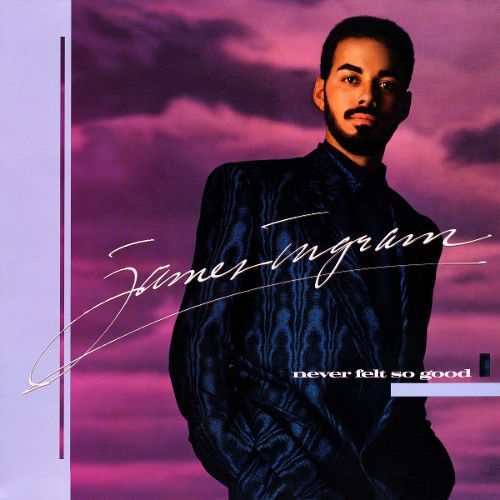
For his sophomore album in 1986, Never Felt So Good, Ingram teamed with Trinidadian co-writer and producer Keith Diamond, who’d previously created hits with Billy Ocean. The album’s songs aimed for a mainstream radio audience but fell somewhere between pop and R&B, never firmly landing on either side of that divide, so fewer of this album’s tracks are well-known today. Still, solid numbers like the album’s opener, “Always,” sound excellent now despite (or because of) the mid-‘80s synthesizer timestamp; a standard upbeat “always and forever” love song, the appeal of “Always” for me has more to do with its slightly brooding mood and how Ingram’s voice flows up and down the scale in ways that few other vocalists from that era to the present day have been able to match successfully. The album’s title track and songs like “Red Hot Lover” dovetail well with the electronic technology that dominated the pop music industry throughout those years.

Ingram returned to the spotlight in 1989 with the release of It’s Real, his third album and the last one to see major action on the charts, namely with the heartbreaking ballad “I Don’t Have the Heart,” which rose to Billboard’s #1 position in 1990 and also fared well as an Adult Contemporary single, though the response of R&B radio was more lukewarm. By this time, just as the hip-hop revolution was on the verge of beginning, Ingram had already begun to seal his fame as a successful crossover artist, mainly through a string of songs featured on Hollywood movie soundtracks. The best-known of those songs was “Somewhere Out There,” Ingram’s duet with Linda Ronstadt from Don Bluth’s 1986 animated feature film An American Tail. Ingram’s other soundtrack numbers and duets (with everyone from Dolly Parton to Anita Baker) included songs from a diverse roster of mainstream fare: Beverly Hills Cop II, City Slickers, Beethoven’s 2nd, and Forget Paris.

Questlove, drummer for the band The Roots, perceptively commented on Instagram after James Ingram’s death that Ingram comfortably came to inhabit a place that would have otherwise been occupied by vocalists like Kenny Loggins or Barry Manilow. While Ingram’s early R&B career was jump-started by Quincy Jones, Ingram also moved in circles that included soft-rock producers like David Foster, and eventually, even new-age musicians like John Tesh. Nevertheless, at the level of his voice, Ingram never strayed far from his R&B origins and always retained a sound that was totally identifiable to those who were already familiar with his vocal legacy. That precise territory remains Ingram’s alone, and I can conclude with certainty in predicting that no other singer will ever sound exactly like him.

Monday, December 31, 2018

Six Favorite Movies of 2018

It’s been my annual tradition to write a year-end post about my five favorite movies of the year, but for my latest post looking back on the films that I saw in 2018, I’ve decided to expand it just a bit to include six movies this time. I definitely feel like I enjoyed more movies overall this year, and 2018’s cinematic fare to me was slightly higher quality. I still think there’s some connection to the worldwide political turbulence that we’ve witnessed recently, partly because art is our most powerful way of pushing back against all of that, as well as tuning it out on some level, in order to focus on more important things that speak to our common humanity and the stories that unite us. That’s one thing movies are supposed to do: build bridges between people and cultures to help make our lives more complete.

My favorite film of 2018 was English director Andrew Haigh’s moving and original road movie Lean on Pete, which he adapted from Willy Vlautin’s 2010 young adult novel. I totally loved Haigh’s 2011 film Weekend when I saw it back then, and I really vibed with the gay men and smart dialogue that he presented in that movie; Haigh and I are the exact same age, so when I’m watching his films, it’s like we speak a similar interior language as gay men from a certain generation. Although there’s no gay storyline in Lean on Pete, Haigh’s sensitivity in representing the itinerant life of a teenage boy named Charley (played by the extraordinary Charlie Plummer) who’s abruptly cut adrift from his family and society — while also finding solace alongside an end-of-the-line quarterhorse called Lean on Pete that becomes Charley’s reliable companion — spoke directly to me on deep and multiple levels. For whatever it’s worth, no film this year made me cry as hard as Lean on Pete. I was so emotionally shaken when I left the cinema that I wasn’t even sure if I’d be able to drive myself back home after the movie, though I made it back just fine.

I wouldn’t want to give away too many of the details in Lean on Pete, so instead I’ll mention some individual aspects of the film that still stand out in my memory. Several scenes are classic and indelible, such as a scene in a roadside diner where Charley is forced to make a life-or-death decision, as well as the scenes in which Charley walks and talks quietly to Lean on Pete as the two make their way across arid desert landscapes. It’s a picaresque story, so Charley also meets some memorable characters along the way: a cruel yet paternal horse wrangler (Steve Buscemi), a kind and sisterly jockey (Chloë Sevigny), and a disturbed young veteran (Steve Zahn). The artful, widescreen cinematography of Magnus Nordenhof Jønck, who’s often working with a muted palette of magic-hour pastels in the film, leaves a profound and lingering impression from one chapter of Charley’s journey to the next.

Another movie about a boy and his horse that I loved nearly as much as Lean on Pete was Chloé Zhao’s spare and patiently calibrated film The Rider. The director has mentioned that about half of the film is “true” in the sense of documenting a young South Dakota bull rider/horse trainer and his family of Native American ancestry, while the other half of the film is scripted and “fictional.” The young man, who is recovering from a serious head injury after being thrown to the ground in a riding accident, is played with remarkable candor and restraint by amateur actor Brady Jandreau, in one of the very best cinematic performances of its kind. Jandreau inhabits his character Brady Blackburn’s predicament entirely believably because he lived it. He’s also beautiful to watch throughout the film, as fluid and magnetic when he’s breaking in a wild colt as he is when his sister places small gold stars all over his chest while he sleeps.

If Alfonso Cuarón’s latest film Roma doesn’t win this year’s Oscars for Best Picture and Best Director, then I’ll probably never watch the Oscars again because Roma is as accomplished as Fellini’s finest movies. A personal remembrance of Cuarón’s childhood in Mexico City and Cleo (Yalitza Aparicio, also Oscar-worthy), the character based on a maid who raised him and his siblings, Roma is a truly monumental film, both in its cinematic scope and in its secure place in the history of movies about memory. Filmed in grayscale black-and-white, the movie poetically and seamlessly constellates its imagery in ways that burrow far into thematic meaning and interconnectedness. Water rinses across a tiled stone driveway throughout the opening credits, but we’re not aware until later that the film’s focus will become the very housekeeper who’s washing that driveway down. We see an airplane fly overhead in the reflection of that water, too, an image that will re-appear at the end of the film in a neat circle, one that also suggests the need for escape, as well as the imminent arrival of the age of globalization. Cleo’s own background as a Mexican villager, which is integrated in quieter rather than overt ways, is a touchstone for the grim legacy of colonization, a legacy that echoes throughout other tragic upheavals that occur later in film.

After reading the abysmal reviews of Lars von Trier’s new film The House That Jack Built, I’d never have predicted that the movie would end up on this list. Masquerading as a mock-drama that shocked audiences and prompted walkouts at this year’s Cannes Film Festival, the film is actually more of a darkly perceptive comedy that follows the over-the-top escapades of a serial killer, portrayed by Matt Dillon in a performance so consummate that he can basically just retire now. The seemingly mundane and brutal surface of the movie might deceive most viewers into missing the film's ambitious allegorical underlayers. Lars von Trier has discussed, provocatively, that the main character Jack is closer to himself than any other male character from his films, suggesting that the movie is actually an examination of the role of the artist in society, even an examination of Lars von Trier’s own body of work. I think the only way to really “get” the film is to be an artist who’s willing to forego human comforts like love and family in favor of art itself. The movie descends into Dante’s Inferno in the end, with Jack’s Dante following Bruno Ganz’s Virgil as they proceed through carefully stylized circles of hell. It’s the most exciting final half-hour of any movie that I saw this year.

For my review of Christophe Honoré’s Sorry Angel in my coverage of this year’s New Hampshire Film Festival, I already wrote most of what I needed to say about that fantastic film. Its many rich characterizations and its dialogue have continued to haunt me, however, over the past two months since I saw the movie. What I’ve realized since then is just how invested the director is in resurrecting his youthful experiences through those particular characters. What did it mean as a gay man back in 1993, under the threat of potentially losing one’s friends and lovers to AIDS, to want to have a child with a female friend and raise him in tandem? And what did it mean for gay and bisexual men of that generation to want to love anyone at all, in the midst of so much widespread loss? Which parts of that love were actualized, and which parts of that love remained only imagined?

Finally, as a kind of wildcard bonus, my favorite feel-good movie of the year was Travis Knight’s Bumblebee, the only Transformers movie I’ve seen. Sure, there’s enough standard action-sequence mayhem in Bumblebee to appease the fans of those films, with John Cena’s character on a military mission to track down the rogue autobot B-127, who’s been hiding out as a yellow Volkswagen Beetle in the family garage of Charlie — a kind-hearted tomboy winningly portrayed by Hailee Steinfeld — after Charlie discovered Bumblebee in a junkyard and revived him by accident. Set in 1987, my favorite year in pop music, Bumblebee features hits by everyone from Steve Winwood to Sammy Hagar to Nu Shooz, and snippets of many other excellent songs cleverly punctuate the soundtrack. The movie’s bittersweet tone recalls Steven Spielberg’s E.T. and the ’80s Ally Sheedy-starring classic Short Circuit, so the nostalgia is built right into the plot. All of the films that I love best from that era never hesitated to uplift the audience and make the full range of human emotions worth experiencing, and Bumblebee wonderfully recreates and pays tribute to that same form of cinematic generosity. As Hailee Steinfeld sings in her awesome end-credits track, Bumblebee brought me back to life.

Sunday, November 25, 2018

Cocteau Twins, Heaven or Las Vegas (Capitol Records/4AD, 1990)

Three of my favorite musical statements about motherhood in the pop music lexicon are Madonna’s Ray of Light (1998), Björk’s Vespertine (2001), and Tori Amos’ The Beekeeper (2005). The fourth is Cocteau Twins’ 1990 album Heaven or Las Vegas, which also remains among my very favorite albums nearly thirty years after its release. With bursts of lyrical intelligibility and swooning vocal flourishes that border on rhapsodic, Elizabeth Fraser celebrated throughout these ten songs the experience of giving birth to her first child, Lucy, with Cocteau Twins bandmate Robin Guthrie.

When I first heard Cocteau Twins back in August of 1990, I was still only a babe myself, a 16-year-old boy growing up in a condominium subdivision of suburban Cincinnati, Ohio. Somewhat embarrassingly, my introduction to the band was seeing the video for “Iceblink luck” on MTV. I’d never heard of Cocteau Twins before that, and I certainly had no idea who Jean Cocteau was at that time. As a gay kid who listened to pop radio constantly, I was, understandably, totally hypnotized by the song, which sounded to my unsophisticated ears as though it had landed from elsewhere in the galaxy. I felt about it the same way I felt about classical music: intrigued and reverent, without any need for a narrative through-line or explicitly logical connections. I just wanted that sound to surround me.

My job that summer was working at Camelot Records in Northgate Mall, so I purchased the cassette tape of Heaven or Las Vegas with my employee discount after my very next shift. (For me back in those days, every dollar that I earned was equivalent to one-seventh of a new cassette tape.) I remember listening to the album non-stop throughout that fall during my senior year of high school, my moods coasting along on Simon Raymonde’s swells of bass guitar. Even then, I felt that I’d tapped into something new and meaningful, and that I’d started to turn something of a corner, away from being interested in pure pop and toward something more obscure, though still in a similar realm.

That’s probably what’s most interesting to me about more obscure popular music, or any music that attempts to get closer to pop without ever fully wearing the traditional pop wardrobe. There’s a certain palpable friction when you can hear a band stretching to fit into pop attire, bending the sound down toward the three-minute mark, structures that the masses out in Radioland can respond to, as if the sound’s been reshaped by moving in the direction of applause. Who wouldn’t want to find a vaster listenership by creating music that’s more widely appreciated?

While Heaven or Las Vegas is often cited as a Cocteau Twins fan favorite and is easily considered their album with the greatest mainstream appeal and accessibility, the concessions in retrospect are minimal, while the dividends still seem high. Although some might feel this was an artistic compromise, even in a pop setting the album is a daring challenge. Elizabeth Fraser’s intonations of her own devising may be slightly more comprehensible here than elsewhere in Cocteau Twins’ catalog, but tiny islands of comprehensibility make the songs even more elusive in a way, tilting into bliss in order to escape the continual grasp of the listener, rushing into spaces of dazzling disorientation (and escorted there by Robin Guthrie’s ethereal guitars and synthesizers), the same way that having a newborn baby entirely revises one’s sense of focus and being in the world.

From the album's opening track, “Cherry-coloured funk,” the song’s title and darkness-to-light sonic shifts evoke the emotional extremes of new motherhood, feeling excited and overwhelmed by love, re-grounded by life, a more cheerful or “rose-tinted” view rising in the wake of postpartum depression or mere exhaustion. The noticeable trip-hoppy drum loop on “Pitch the baby” underscores its crystal-clear choral line, “I only want to love you.” Of course, “Iceblink luck” features the starkest set of lyrical fragments; semi-audible lines like “burn this whole madhouse down,” “you, yourself and your father,” and “thank you for mending me, baby” all lead into the quietly propulsive “Fifty-fifty clown.” Then, right at the midway point of the album, the glorious, neon-drenched title track pretty much permanently puts cheerfulness back into goth, never to be fully erased again.

Part of what made me want to write about this album was recently seeing the gay French director Christophe Honoré’s latest film, Sorry Angel, and being completely psyched to hear “I wear your ring” suddenly pop up on the movie’s soundtrack during a particularly gorgeous sex scene. What an inspired choice it was. The song’s sound is indelibly bound to dusk and twilight, to nighttime and romance, waltzing through dark waves of glitter “between the sunrise and sunset” to arrive at some kind of agreement or consolation in the presence of someone else in a silent room. “Fotzepolitic” (literally German for “vagina politics”) then takes over like an awakening for “I wear your ring,” both joyful and unbridled. The pulsing “Wolf in the breast” and contemplative “Road, river and rail” move from the intimate interiority of “my baby’s cries” to a sprawling exterior countryside or landscape, with a forlorn figure drifting gently across it in the distance. And finally, the album’s somber closing number, “Frou-frou foxes in midsummer fires,” slowly floats from netherworld to dream-world, which turns out, naturally, to have been the true resting place of Cocteau Twins all along.