Showing posts with label jeffrey friedman. Show all posts

Monday, June 17, 2019

21st Annual Provincetown International Film Festival (June 12th - 16th, 2019)

Amazingly, this was my fifteenth year attending the annual Provincetown International Film Festival, and it was my tenth year reviewing movies at the festival. I always look forward to returning to Provincetown for the festival every year in mid-June, and it’s easily my favorite week of the year. Whenever I show people my schedule for the festival, they ask how I select the movies that I watch for my reviews. I tend to aim for a balance in my line-up both thematically and stylistically, dictated somewhat by timing, and I also strive for a blend of independent and mainstream fare. Deciding on which films are most important for me to see is like fitting together a puzzle based partly on the festival schedule itself. This year I fit in fifteen films (eight documentaries and seven narrative features), as well as one program of short films, in addition to attending various parties and events held all over Provincetown throughout the week.

While all of the movies that I watch each year at the festival turn out to be totally fine and quite frequently better than fine, I always anticipate the films — usually those somewhat outside of the mainstream — that either surprise me in some way or quietly settle into the mind and present themselves as art. What’s interesting is how the films that feel most artful to me also feel so readily identifiable as such. They always have a true integrity of structure and allow the audience lots of room for thought as well as mystery. Because the medium of film is distinguished by sequencing images to convey narratives and emotional states, I find that the most special films rely less on familiar codes or formulas and more on their own intuitive and innovative frameworks.

My favorite movie at this year’s Provincetown Film Festival was the mesmerizing documentary Honeyland, directed by Ljubomir Stefanov and Tamara Kotevska. Honeyland won three awards at the Sundance Film Festival, and it’s clear why the movie has received such high praise. Remarkable on numerous levels, the documentary is set in a remote mountain encampment in Macedonia, a semi-abandoned village that’s stuck in time and poverty, but where life is being vividly lived. The film follows a 55-year-old woman named Hatidze, who shares a tiny primitive hut with her ailing 85-year-old mother, tending to her needs despite having no electricity or running water. Hatidze is a beekeeper and an expert at collecting honeycombs teeming with bees from steep mountainside ledges and crevices, so that she can harvest and sell jars of raw honey to local merchants, providing her and her mother with just enough money to survive. Her one rule is to leave half of the honey for the bees themselves, pouring it out on a large boulder, and then keeping the other half for herself. The beekeeping scenes and the landscapes that Hatidze traverses are often mind-blowing, widescreen sequences that rival anything that’s ever been filmed in the region.

Throughout the documentary, there are distant but prominent glimpses of a globalized wider world: vapor trails of jetliners ascending into the sky, at which villagers of all ages give the same bemused look, and multiple attempts to get reception on a small outdated radio that seems to be playing the same song whenever the signal comes through clearly enough to hear. Tension mounts and continues to escalate with genuine suspense when a nomadic family, including lots of small children, become Hatidze’s less-than-friendly neighbors, killing off her bees and losing a shocking amount of livestock to starvation and lack of care. The filmmakers regard these tragedies with the same steady eye that they’ve maintained up to that point in the documentary, an approach that makes the cumulative impact and our investment in Hatidze’s heartbreaking predicament all the more affecting. Transporting and multi-scale, Honeyland should certainly be a frontrunner for awards attention come Oscar season.

At the other end of the documentary spectrum and much closer to home is Chris Moukarbel’s new HBO film Wig, a riotous before-and-after exploration of drag artists through the lens of two long-running New York City drag festivals, Wigstock and Bushwig. Moukarbel has previously directed documentaries about Lady Gaga (2017’s Gaga: Five Foot Two) and YouTube phenomenon Chris “Leave Britney Alone!” Crocker (2012’s Me at the Zoo), and here Moukarbel’s camera chronicles an equally colorful array of subjects via an intergenerational cross-section of drag queens and performance artists, from the legendary Lady Bunny and RuPaul to Kevin Aviance and Flotilla DeBarge, alongside younger sensations like Willam Belli and Charlene Incarnate. They all offer thoughtful (and sometimes hilarious) commentary on cross-gender and trans issues, much of which responds to the current climate that’s precipitated the #MeToo and Time’s Up movements. As one commentator remarks in voiceover early in the film, regarding the importance of drag queens’ celebration of their own femininity, “The world is sick with masculinity.”

Even Neil Patrick Harris and his husband David Burtka make a fun appearance in the documentary, with their kids running crazily around their house in the background, since Harris was involved in the return of Wigstock in 2018, after the festival had taken a lengthy hiatus following the September 11th attacks in New York City in 2001. Harris, who portrayed the title role in the Broadway debut of Hedwig and the Angry Inch, explains that his fascination with drag is directly related to his work as a stage magician, and how exactly drag artists pull off their gender-based illusions through make-up, costuming, and detailed sleights of hand (among other anatomical parts).

Moukarbel’s documentary also gives room for some playful drag community shade-throwing, when Lady Bunny tells the spectators at the rebooted Wigstock that she hadn’t yet appeared on RuPaul’s Drag Race so she could read all of the drag queens who had, resulting in a live song-and-dance takedown of those contestants to the tune of Madonna’s “Vogue.” Reflecting back on 1995’s original Wigstock documentary, it’s obvious while watching this new Wig how relatively mainstream drag has become over the past 25 years. When Moukarbel was asked by an audience member during the post-film Q&A in Provincetown if he was old enough to attend the original Wigstock festival, he answered that yes, it was definitely a vital memory of his own queer generation, and he said that the original Wigstock film had been very important to him and his friends back then, before the cultural spotlight on drag had gone more fully global.

The narrative feature film that lingered with me the most from this year’s festival was Argentine director Lucio Castro’s End of the Century (Fin de Siglo), the unique and cleverly rendered story of two men, Ocho and Javi, who meet on a beach in Barcelona, hook up for sex later (quite memorably), and then re-enter each other’s lives in unexpected ways at irregular intervals through several twists in time that don’t neatly align or allow the audience any simple resolutions. All the accoutrements of contemporary gay relationships are on the table throughout the movie’s timespans: casual flings, bisexuality, PrEP, marriage, children, loneliness and separation, co-dependency versus independence. Several symbols link the two characters’ arcs together as a way of guiding the audience through the movie’s timeframes associatively: a certain aerial view from a balcony, a re-appearing KISS t-shirt, a recurring illness, sexual tropes of new partners and familiar couples.

Well-acted (by Juan Barberini as Ocho and Ramón Pujol as Javi), intelligently conceived, and finely executed, End of the Century works best as a way of comparing the different paths that a gay relationship can take. To what degree do our current and future relationships overwrite our past relationships? What do we remember of them and carry forward with us? Are we always essentially alone, even when sleeping beside the same person for years? Do the heat and intensity of an initial sexual encounter ever really leave us, or do they continue to live inside us, both physically and in memory? An exhilarating scene midway through the film, set to the beat of A Flock of Seagulls’ “Space Age Love Song,” probably answers that last question best, and a few of the movie’s dialogue-based scenes resonate on deeper levels and feel almost like stage pieces, reminiscent at times of Andrew Haigh’s brilliant Weekend.

Tom Harper’s Wild Rose was the most enjoyable of the narrative features that I saw at the festival, with rising Irish star Jessie Buckley in the title role of Rose-Lynn Harlan, in what’s sure to be one of the most lasting performances of the year. The film begins just as Rose-Lynn is being gleefully released from a year in prison for drug charges, returning with her white cowboy boots and ankle monitor to the home of her mother (Julie Walters) and her own two young children in Glasgow, Scotland. Although Rose-Lynn finds work as a housekeeper for the family of a well-to-do woman (Sophie Okenedo), Rose wants to move to Nashville to pursue a career as a country singer and eventual songwriter, a dream that her vocal talents uphold, persuading others in her life to help her get there.

What’s excellent about Wild Rose is the indirectness of that journey. Instead of finding herself in a corridor full of open doors, Rose-Lynn faces a daunting series of setbacks and obstacles, from Glasgow to London to Nashville, meaning that the film unfolds in a fashion opposite the standard reach-for-your-dreams Hollywood formula film. The storyline skitters away from melodrama and towards the real thing, in ways that gradually steady Rose-Lynn’s ambitions and heighten her determination. Jessie Buckley’s unwavering portrayal and precise songwriting in the movie’s original numbers are fully embodied (especially in the film’s big finale, “Glasgow”), despite the glare of Julie Walters’ stern mother figure, who finally softens when her daughter needs her the most. Wild Rose earns its gently family-centric denouement, which most other movies of its kind unfortunately don’t these days.

Throughout the festival, I was lucky to see a wonderful selection of documentaries about celebrated American pop culture figures: singer Linda Ronstadt, actor Montgomery Clift, and film critic Pauline Kael. The one animated film that I saw in the festival, Salvador Simó’s Buñuel in the Labyrinth of the Turtles, re-imagines in cartoon form the making of Spanish filmmaker Luis Buñuel’s 1933 documentary Land Without Bread. One short film that I watched on the festival’s opening night also haunted me for days afterwards, Lovell Holder’s spellbinding You Say Hello, in which a young gay man retreats to his family’s California beach house in Ventura planning to commit suicide, only to have that plan undone by a sweet straight hustler he hires online for the night.

Perhaps the most timely and relevant moment of the festival for me came when I attended a conversation with Oscar-winning documentarians Rob Epstein and Jeffrey Friedman on the final morning of the festival. (Their new documentary Linda Ronstadt: The Sound of My Voice also won this year’s HBO Audience Award for Best Documentary at the festival.) While discussing the historical roots of their films, which have examined subjects ranging from the legacy of Harvey Milk to the AIDS memorial quilt to LGBTQ images in cinema, Rob Epstein described how our culture now is beginning to lose interest in history because everything in daily life and social media is so fast-paced and focused on the present moment. Plus, he added that after the AIDS epidemic, there’s a missing generation that would have been teaching that history to us. Restoring and continuing those kinds of historical learning are just a couple of important goals that many of the films I watched during this year’s Provincetown Film Festival generously seek to achieve.

Sunday, June 27, 2010

12th Annual Provincetown International Film Festival (June 16th - 20th, 2010)

Perhaps I just selected my list of films well or got lucky, but out of the six years that I’ve attended the Provincetown International Film Festival, this year’s 12th annual festival seemed to have the strongest programming. Over the festival’s five days, I watched seven narrative feature films, eleven documentaries, and one program of short films. I also attended the Awards Ceremony, which honored several cinematic luminaries, some of whom I was pleased to have a chance to meet. I’ll share some in-depth comments about my four favorite films from the festival here, as well as some brief thoughts on two other films that I enjoyed almost as much.

Cairo Time, written and directed by Ruba Nadda (and already available on DVD in Canada), was my favorite film in the festival. Producer Christine Vachon introduced the film by letting the audience know that the script had found its way to her via Canadian director Atom Egoyan, and she also noted that the film stars Patricia Clarkson in her first major leading role. Clarkson has long been respected as a character actress in many excellent independent movies, beginning with her breakout performance as the hilariously deadpan Greta in 1998’s High Art.

In Cairo Time Clarkson plays Juliette, a New York magazine editor who’s traveling to Cairo for the first time to meet her husband there. He’s a United Nations official who’s been unexpectedly delayed for several days, however, by his work in Gaza. So Juliette takes to exploring the city herself, potentially dangerous for a middle-aged blond woman to do on her own. Crowds of men follow her lasciviously, and she learns to stay much closer to her hotel. Fortunately, one of her husband’s Egyptian friends, Tareq (portrayed with quiet charm by Alexander Siddig), steps in to act as her chauffeur and personal escort. The ancient city’s pyramids and continual snarls of traffic provide the backdrop for their love affair that never fully becomes an affair.

The film echoes Sofia Coppola’s Lost in Translation (2003), but Cairo Time is a more mature rendition of a very similar story, with an older woman playing the Scarlett Johansson role. Thanks to Patricia Clarkson’s attentive emotional exactitude, her Juliette is also more reserved and fascinating to watch. It’s a performance of the utmost delicacy that’s also fairly assertive; an implicit streak of feminism underlies the character’s intentions. Each subtly romantic move between Juliette and Tareq is carefully choreographed, respectful of the story and of women. This quality of tacit civility between its romantic leads and the film’s wonderfully languid pace make it feel like a movie from another era, the kind of film that simply doesn’t get made anymore. It's a very particular touch that has mostly faded from the world of cinema, which is part of what made Cairo Time a profound movie-going experience for me.

The festival’s opening-night feature, Howl, directed by acclaimed documentarians Rob Epstein and Jeffrey Friedman, is about Allen Ginsberg’s epic 1955 Beat Generation poem, perhaps the most infamous poetic masterpiece in 20th-century American history. Part literary meditation and part biopic, the film imaginatively recreates the classic countercultural poem and pays sincere homage to it, while also resurrecting a young Ginsberg himself through the precise and rigorous performance of James Franco. A movie about a poem seems unlikely to gain much mainstream attention, but Franco’s reincarnation of Ginsberg should help to make him a bona fide star when the film is released later this year.

Franco’s performance is equally intelligent and brave. The actor has been studying film and writing in New York City for the past few years; in fact, I also saw his first short film, an adaptation of Anthony Hecht’s poem “The Feast of Stephen,” in this same festival. His investment in believably embodying a figure as monumental as Ginsberg is at once palpable and relaxed. And in our post-Brokeback Mountain era—when playing a gay character who interacts physically with other men no longer means career suicide for young male Hollywood stars—Franco’s scenes with the actors playing Neal Cassady and Ginsberg’s longtime partner Peter Orlovsky feel both undeniably sexy and authentically beautiful. (Yes, I was melting in my seat.) I commend Epstein and Friedman for making sure that these scenes were filmed honestly and realistically, and for knowing how to present them that way within the film’s broader context.

What’s most remarkable about Howl is that the screenplay is comprised almost solely of primary source materials: the actual text of Ginsberg’s poem, monologues from archival interview footage with Ginsberg (which Franco painstakingly re-enacts), and the court transcript from the 1957 obscenity trial surrounding the poem. This explains why we don’t hear much dialogue spoken by Orlovsky, Cassady, or Jack Kerouac during the film. The script’s various elements are interspliced throughout and linked together by the courtroom trial, with a roster of first-rate actors playing the lawyers and literary experts on the witness stand. Jon Hamm, of television’s Mad Men, is especially affecting as the defense attorney; his closing argument is a truly virtuosic piece of acting, in which his eyes alone convey vast measures of conviction, emotion, and professional restraint simultaneously. His final words urge the judge, and us, to consider that art — and the appreciation of art, by extension — should be in pursuit of “honest understanding.”

Howl represents the poem itself by re-staging Ginsberg’s early public readings, along with fantastical animated sequences designed by artist and graphic novelist Eric Drooker, who collaborated with Ginsberg on the 1992 book Illuminated Poems. The animation works well at various points in the film, especially during the darker “Moloch” section of the poem. After thinking about the film for a few days after seeing it, I came to appreciate the suitability of the animated segments even more when I realized that Ginsberg’s poem is itself much like a cartoon, a colorful, expansive exaggeration of the Beat Generation’s key figures and political views, of the many things that they loved about American culture (sex, drugs, liberty, the desire to be all-embracing) and the more oppressive, conformist things that they despised. I think that the film will come to be deeply admired with the passing of time, just as Ginberg’s poem has.

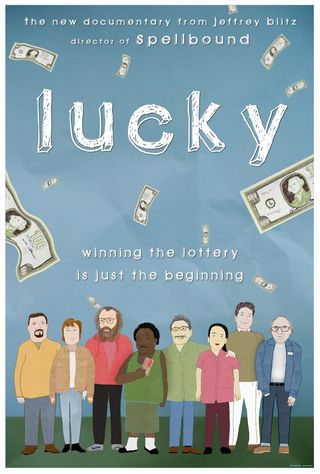
Two of the festival’s documentaries also stood out to me, out of the sizable number that I saw. My favorite was director Jeffrey Blitz’s Lucky, a captivating exploration of the various fates of American lottery winners in the aftermath of receiving their gargantuan cash prizes. The tales range from a humble married couple who won over $100 million and moved with their two teenage kids to a gated community in Florida (where they filled their garage with expensive sports cars and cemented the tiled letters “PB,” for PowerBall, at the bottom of their swimming pool), to a man who extravagantly spent all of his $12 million winnings and is now dying of lung disease while living in a mechanic’s shop, where he runs errands for a meager wage.

In the Q&A session afterwards, Blitz commented that viewers of the film are always most curious about the former lottery winners who lost everything or went bankrupt. Money is usually far easier to lose than it is to gain, so I found the intimate details in the film to be more intriguing. For instance, the story of a family of Vietnamese immigrants who barely escaped their war-torn country in a large wooden boat, and who’ve now built palatial homes for their family members left behind in Vietnam, moved me and many others to tears when they spoke about the struggles they’d faced. But the message of the film seems to be that no matter how tragic or triumphant your story, you still have to deal with your everyday life and thoughts, and all of the things that those might or might not amount to. Blitz also directed the amazing 2002 spelling-bee documentary Spellbound, and he’s quickly become a brilliant observer of the many joys and complications involved with being a citizen of the meritocracy known as the U.S.A.

Belgian filmmaker and NYC transplant Frederic Lilien’s The Legend of Pale Male was the other most engrossing and heartfelt documentary that I saw at the festival. Certainly, the red-tailed hawk known as Pale Male, who first arrived on the scene in New York City in the early 1990s, became a legendary news item after setting up house with a series of female mates by building a huge nest atop a swanky Fifth Avenue apartment building, where the celebrity residents include the likes of Mary Tyler Moore, among others. Bird-watchers and children from all over the world converged in Central Park to delight in seeing the aerial acrobatics of Pale Male on a daily basis. Disenchanted with his father’s law business back home in Belgium, Lilien decided on the spur of the moment to become a wildlife filmmaker right on the streets of New York, following the tale of Pale Male for the better part of a decade. Lilien’s own story gently bookends the documentary, and the film includes some of the most breathtaking photography of New York that I’ve ever seen in any medium.

Pale Male sired a number of young hawks over the years, until conflicts arose and the apartment building’s owners decided to evict the hawk and his family by dismantling and removing their carefully constructed nest. For those unfamiliar with the story, I won’t give anything else away. Let’s just say that Lilien finds an impressive amount of suspense and humor in the events as they unfold, and his film champions a true avian hero that you can cheer for. It’s rare when a film can make you fall in love with a metropolitan cityscape and the wonder of nature all over again, but given its unique intersection of urban and natural themes, The Legend of Pale Male easily accomplishes that.

As for my two “runner-up” films from the festival, Undertow (Contracorriente), a Peruvian film written and directed by Javier Fuentes-Léon, deserves mention here for its stunning oceanside cinematography and its clever twist on a traditional romantic tale. Miguel, a fisherman, has been secretly involved with Santiago, a visiting bohemian painter, unbeknownst to anyone else in his village, including his pregnant wife. With the help of some deft magical realism, an unforeseen turn sets the plot in motion and forces Miguel to face up to ghosts that he’d rather not confront. And it surely doesn’t hurt that the actors playing the two central characters (Cristian Mercado as Miguel, and Manolo Cardona as Santiago) aren’t at all difficult to look at! This film also received the HBO Audience Award for Best Narrative Feature at the festival.

François Ozon’s Hideaway (Le Refuge) fits snugly into his ever-growing body of work. The French director’s recurring themes and fascinations are all amply evident here: alternative families, bodies, death, and blurred lines of sexuality. Tonally subdued and deliberately paced, this contemplative story concerns Mousse, a young woman portrayed with calm assurance by Isabelle Carré. Her boyfriend Louis, a heroin addict played by Ozon veteran Melvil Poupaud in the first few minutes of the film (note: viewers made squeamish by needles should be aware that those early scenes are hard to watch), dies of a drug overdose and leaves Mousse behind to discover that she’s pregnant with their child. Louis’s gay brother, Paul (played by the gorgeous Louis-Ronan Choisy), looks after Mousse at a secluded country chateau in the wake of their mutual loss. Ozon has already proven his worth as a serious director with a recognizable style, and Hideaway impressively adds to his prolific filmography.

I’ll close with some remarks about the festival’s Awards Ceremony, which took place before a packed house at Provincetown Theater on the Saturday night of the festival. Each of the festival’s honorees participated in a conversation-style interview on stage with a noteworthy member of the film community. First up, Hedwig and the Angry Inch star John Cameron Mitchell (who’s totally adorable in person) interviewed Rob Epstein and Jeffrey Friedman, recipients of this year’s Faith Hubley Memorial Award. Two-time Oscar winners for their documentaries The Times of Harvey Milk and Common Threads: Stories from the Quilt, Epstein and Friedman have also directed such celebrated documentaries as The Celluloid Closet and Paragraph 175. The pair of men were down-to-earth, generous, and disarming, qualities that one finds in liberal supply in all of their films. They insightfully responded to questions about the making of Howl, and about how each of them got their respective starts as filmmakers. I was fortunate to speak with Rob Epstein for about fifteen minutes at the festival’s closing-night party, and I can say that he was just as smart, kind, and personable with me during our talk.

Tilda Swinton, who was seated right in front of me at the Awards Ceremony — wearing a fabulous pair of custom-made pumps specially hand-crafted for the occasion . . . with wooden bananas for heels, no less! — accepted her Excellence in Acting Award following a spirited and often hilarious discussion with the renowned film critic and scholar B. Ruby Rich. It’s no surprise that Derek Jarman’s most famous muse would feel quite comfortable in Provincetown; she said that she welcomed the sandy dunes and beaches after traveling from her home in northern Scotland. Several of her other comments were surprising. She mentioned that she’s never liked referring to her job as “acting,” for example, but rather views it as collaboration (“I think of films as conversations”). She also admitted that she’d initially planned to become a writer when she started her undergraduate career as a student at Cambridge University, until she got involved in theatrical productions and eventually became part of Jarman’s ensemble, or “Derek’s children,” as she affectionately called their group in retrospect.

Finally, mainstream cult-comedy director Kevin Smith accepted his Filmmaker on the Edge Award from John Waters, who’s a seasonal Provincetown resident and himself the longtime king/queen of cult comedies. Though I’ve never seen any of Smith’s popular slacker generation films like Clerks, Mallrats, or Dogma, I did enjoy Chasing Amy and have watched clips online from some of his “stand-up” gigs, for which he’s become equally famous over time. Dressed in his trademark outfit of baggy calf-length blue jeans and a sports team hoodie, Smith was sweating buckets throughout his extremely lively conversation with Waters, constantly ratcheting up the outrageousness, while testing the mannered New England audience’s limits with swift, manic, profane, free-association humor. Eventually, everybody gave in to Smith's witty rants and storytelling, and the whole place (including Tilda Swinton) was laughing uproariously.

The big finale of the evening came when Waters hesitantly asked Smith, “Can’t you afford to fly first-class?” The audience took a collective gasp, since he was clearly referring to the recent, widely publicized incident in which Smith was ejected from a Southwest Airlines flight, purportedly because he was too large to fit into a passenger seat in coach. Smith’s rambling but seemingly well-rehearsed reply went on for nearly twenty minutes, and every single minute was worth hearing. He explained that he refuses to fly at all now, and drives everywhere around the country in a big tour bus.

The most revealing moment of the night, however, was when Waters summed things up by saying, “So it sounds like you turned the whole situation into comedy! What else can you do with pain?” That remark provides perhaps the best explanation of why both directors have made the kinds of movies they’ve made, though as many of the films in this year’s Provincetown International Film Festival abundantly prove, not all pain results in comedic art. I’m very grateful for that, and for the infinitely dazzling mosaic of human stories represented by these films.