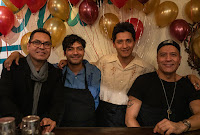
One true highlight of the festival for me was the chance to talk with energetic young artists and filmmakers at the various parties around town throughout the week. During Saturday’s press luncheon I had a fun conversation with the talented actor Antonio Marziale, who recently starred in the 2018 Netflix film
Alex Strangelove, just a day after I’d watched his edgy new gay short film
Starfuckers, which he also wrote and directed. His daring short shows a ton of promise by crafting an atmospheric Hollywood revenge tale that’s both innovative and distinctively rendered in a poetically compressed timeframe. Later at the filmmaker party on Saturday night, I also enjoyed talking with Fredgy Noël about her new short documentary
The House of Labeija, which re-contextualizes some key members of that legendary drag-ball house, first introduced to the world in Jennie Livingston’s 1991 classic documentary
Paris Is Burning. I’d been teaching my students in my summer course about Crystal Labeija, the house’s founder, only a week ago, so I look forward to seeing Fredgy’s short when it begins streaming at noon today on the festival’s website for viewers anywhere in the world to watch.
Provincetown has always been and still remains today a collectivity of inspired and spirited misfits, coming together at the edge of the world to advance our creativity and create social and artistic change. As a longtime resident of Boston, I’ve been a regular year-round visitor to Provincetown for nearly three decades now, and I’ve been attending and reviewing the annual film festival for almost two of those decades. (The festival will soon be celebrating its 25
th year in 2023.) Witnessing the collaboration of everyone who organizes such a fantastic film festival every year has provided me with many real lessons in community-building, and what a unique community of people it continues to be. As this year’s Filmmaker on the Edge honoree Luca Guadagnino hilariously summed it up during his conversation with John Waters at Sunday’s awards ceremony, “The only two people here who aren’t perverted are you and me, John.”
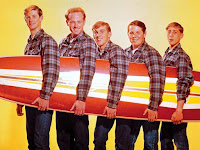
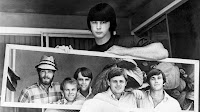
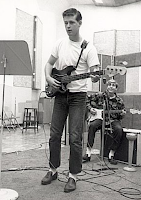
Although I was born just a decade after the release of The Beach Boys’ 1962 debut album
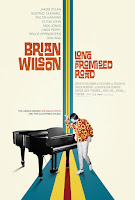
Surfin’ Safari, their music always felt to me kind of like the playfully distant past, steeped as it is in a carefully cultivated sense of pop nostalgia. Nevertheless, the legendary story and career of Brian Wilson still retain a certain allure for me, and it’s clear why so many other longtime listeners are equally drawn in by his continued trajectory through pop music history. Brent Wilson’s recent documentary
Brian Wilson: Long Promised Road presents perhaps the most personal view of Brian Wilson’s contributions to that history, a truly close-up portrait in terms of artistry, musicianship, and emotion, along with insightful analysis and commentary from the likes of Bruce Springsteen, Elton John, Don Was, Linda Perry, Jakob Dylan, and even Nick Jonas (whose own career was launched, just like Wilson’s, in a popular band with his two brothers). The result is a film that’s intimate, moving, and at times heartbreaking in its exploration of Wilson’s art and world.
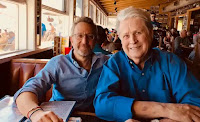
Brian Wilson’s guide and sidekick throughout the documentary is
Rolling Stone writer and editor Jason Fine, whose easygoing and gently calibrated interviewing style helps to relax Wilson’s nerves and allay his anxieties about participating in the film, a very particular sort of skill that Fine has developed since Brian Wilson has been his “beat” at
Rolling Stone since 1995. The majority of the documentary shows the two hanging out over a series of interview lunches at the Beverly Glen Deli, and mostly just driving around the streets of Los Angeles with a dashboard camera to revisit key landmarks from Wilson’s past, while talking and listening to music together. The ultimate impression those conversations leave is that Wilson must be among the sweetest musicians on the planet, one whose persona and disposition have been characteristically misunderstood by some throughout his time in the music industry, while also being unrelentingly championed by others who could see and understand the full picture. In examining both Wilson’s music and prominent factors from his upbringing and family,
Long Promised Road travels some significant mileage to provide many important details and subtly fill in those gaps.
The aspect of Wilson’s experience that moved me most is just how much he’s survived, and how much loss he’s faced. His brothers Dennis and Carl (his closest Beach Boys bandmates, alongside band members Al Jardine and Mike Love) had both died at relatively early ages, dual tragedies that still register painfully in his eyes when Fine asks about his brothers. Wilson remarks that he wants to hear Dennis’ only solo album released during his lifetime, 1977’s celebrated
Pacific Ocean Blue, when they get back to his house because he says that he’s never listened to it before at all, astoundingly, perhaps a willful avoidance of the memories it might dredge up. He sits back and listens intently and excitedly, clearly impressed with the songs as Fine streams them for him on a laptop. Based on Fine’s praise, I went back after watching the film and listened to Dennis’ “River Song,” the album’s opening track, and it’s indeed a fantastic creation that obviously owes a debt to Brian Wilson’s orchestrations of The Beach Boys’ classics in the studio years before.
Similarly, the film’s commentaries by fellow musicians gave me a whole new appreciation for Brian Wilson’s craftsmanship on some of the best songs from The Beach Boys’ catalog: “Good Vibrations” (which I previously had no idea was recorded at
four different studios from verse to chorus to verse, but I can definitely hear that element in the song now), “California Girls,” “Long Promised Road,” the endlessly haunting “In My Room,” “Sail On Sailor,” and especially the seminal numbers from 1966’s
Pet Sounds like “God Only Knows,” which famed music producer Don Was breaks down into separate vocal and instrumental tracks to demonstrate how ingeniously they’re layered. Bruce Springsteen speaks precisely about how the songs gave Wilson access to “the joyfulness of an emotional life,” which he could then share with listeners. The great singer-songwriter and producer Linda Perry perceptively notes how Brian Wilson’s competitive spirit has kept him in the game all the way up to the present moment, a competition not just with The Beatles’ album
Rubber Soul, but mainly with himself. She comments that when she watches Wilson perform today, she sees not age but “fucking history, and continuing to make history.”
That thought returns to the notion of survival. Wilson and Fine openly address Wilson’s history of mental illness and his eventual diagnosis with schizoaffective disorder. Wilson mentions that from his youth onward, he would hear voices in his head taunting him and criticizing him, which seems linked to how his father, who’d managed The Beach Boys early on in their career, would verbally abuse him and often took things too far. For a sensitive artist like Wilson, it’s as though his mind became entrenched in a form of post-traumatic stress in the wake of that intense early criticism that he’d internalized. Wilson was fortunate to meet and marry his second wife Melinda just as his mental health was hitting its lowest point, a relationship that’s consummately recreated by actors John Cusack and Elizabeth Banks in the 2014 Wilson biopic
Love & Mercy. Melinda has remained a steadfast partner and loving guardian to Wilson ever since, and the couple have adopted and raised several children together. As Elton John remarks, Wilson deserves as much praise for the integrity of his personal life as he’s received for the brilliance of his music.
After I watched the documentary, I noticed how many film critics online mentioned in their reviews that they found Wilson’s seeming lack of responsiveness to Fine’s interview questions to be “frustrating” because Wilson often simply states (and re-states) plain facts rather than rationalizing. Yet that seems to miss the point of Fine’s intentionally delicate, intuitive approach to interviewing Wilson, an approach that wisely takes the issue of neurodiversity into account. I’d suggest that the important part isn’t just documenting
what Wilson says when he responds during interviews with Fine, but rather showing
how exactly Wilson responds. For instance, there’s a stunning moment when Fine tells Wilson that Jack Rieley, who’d managed The Beach Boys at one point and also helped to produce their 1973 album
Holland, had recently died. Wilson lets it sink in, says he wasn’t aware, asks how Rieley died, and stares ahead blankly. Then we realize that he’s quickly wiping away tears. A minute or two later, he says to Fine that it broke his heart to learn of Jack Rieley’s death, and it’s clear that Wilson is someone whose mind just processes emotions differently, and therefore causes him to express his emotions differently. Earlier in the film, he also tells Fine that it’s been three years since he’s had a friend simply to sit and talk with, and then we know where the profound solitude, insularity, and loneliness at the heart of a song like “In My Room” arises from. I think it’s something that every wonderful musician who still performs with Brian Wilson on stage today seems perfectly aware of, and it’s something that the audiences who enthusiastically embrace his live performances at his concerts know as well. They’re amazed and grateful that he’s still here to create and perform for us despite the difficulties, and Brian Wilson is just as amazed and appreciative that he’s made it through everything, too.
With the pandemic continuing throughout 2021, it was another highly unusual year for cinema, as movie theaters here in New England faced lengthy (and often quite sudden) shutdowns and hesitant re-openings as public health parameters shifted locally and globally. Some cinemas and theater chains didn’t survive those changes and the subsequent loss of film audiences when more people retreated to streaming films online at home. Somehow, I was able to keep myself going to see movies in person at cinemas throughout nearly the entire year, though the rollout of worthwhile new films was slow and halting, as film companies carefully measured and re-calibrated what might be worth releasing and when. Release schedules continued to get jostled around as film releases were postponed and timed for when they might get the best kind of audience response at the box office. Therefore, as with my year-end post for 2020, just three movies lingered with me most throughout 2021, and in each case, I was drawn to them as much for their subtle emotional pull as for their narrative and visual craft. I felt like these movies spoke to my own levels of sadness at the ongoing state of the world and offered some consolation and distant yet intimate company via their artistry.
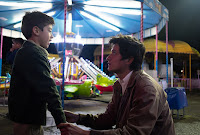
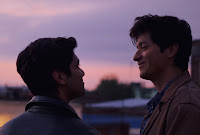
It’s fitting that Heidi Ewing’s moving and relatively little-seen gay Mexican immigrant romantic saga
I Carry You with Me was my favorite movie in a year when Jane Campion’s much-lauded, quasi-gay Western tragic epic
The Power of the Dog could win Best Picture (and Best Director) at the Oscars. While Campion’s novel-like film is certainly finely made, intricately deployed, and superbly acted, its mystifying effect on the mostly straight audience that I saw it with seemed to be its intended goal, whereas a gay male viewer like me could easily see the planted curveballs coming.
I Carry You with Me has fewer tricks up its sleeve, perhaps because it wears its heart more openly there, which isn’t to say that it’s a simple story, nor one that’s simply conceived. Based on the actual relationship of two of Ewing’s gay friends, Iván (Armando Espitia) and Gerardo (Christian Vásquez), a chef and a teacher, respectively, the film follows the two young men from their initial meeting at a club in Puebla, Mexico in the ’80s through their struggles to immigrate to New York City, to nearly the present day and their celebration of their time together running a restaurant there. I was engrossed in their story and right with them every step of the way, and the immigration scenes especially were some of most powerful I’ve seen on film. Their romance is equally well-developed and sincere, at a time when more movies still need that sort of earnest depiction of gay male characters.
Drama and hardship aren’t left out of the picture, of course, since Iván is a closeted and married father of a young son when he and Gerardo first meet, and both face intense and overt familial homophobia during their youth and upbringings. Machismo and the masculine pressure to conform in erasing any form of effeminacy in boys runs rampant throughout the culture, one in which fathers like Gerardo’s and Iván’s are pressured to punish and cruelly abandon their own young sons for the boys’ inability to meet their society’s unfair masculine standards. For that reason, it’s also quite uplifting and reaffirming to watch a gay film in which the characters can all transcend those hardships and eventually overcome their obstacles to actualize their dreams. The moment when Iván’s chance at fulfilling his ambitions finally arrives by happenstance in the kitchen of a Manhattan restaurant was perhaps the most moved I felt at the cinema this past year.
The best innovation of the movie is the twist in its latter half, when we meet the characters in their older incarnations; rather than using actors, all of the characters are simply portrayed at that point in the film by the real-life people themselves. It’s the perfect way for Ewing to balance the often dreamlike tone of the film’s first half and to allow these two men to claim their own story, as well as giving the audience a true opportunity to get to know them. (Also, it makes sense that the director would shift into documentary mode since her best-known previous films were documentaries.) Despite the acclaim that
I Carry You with Me received at the Sundance Film Festival and at a few other awards ceremonies, it’s dispiriting that the movie earned under $200,000 at the box office upon its official mid-year release, which had been delayed by several months. Cinemas across much of the country were still just beginning to open up again at that point, and audiences were still somewhat wary of going to see movies in person at a movie theater, so clearly those factors were part of why few people have found the film. In an ideal world that would surely not be the case because this is an artfully rendered and deeply human movie that deserves to be widely seen.
Robin Wright’s
Land, her feature directorial debut, was actually one of the first films that I saw at a cinema up in Maine in 2021, way back in late February, just after a shutdown of several months had closed the cinemas there. I didn’t expect to be as emotionally affected by the movie as I was, probably due to a combination of the film’s subject matter, the circumstances in which I watched it by myself in the back row of an almost empty theater, and mainly seeing it at the time when I did, during the first winter of isolation and solitude at the worst point in the pandemic. Just as central to the movie’s power is Wright’s enduring performance as Edee, full of soul and gravity, which lasts for the entire length of the film. Even more impressive, perhaps, is how nearly all of the movie takes place at a single location, inside and around a small cabin high up in the wilderness of the Rocky Mountains in Wyoming (though the actual filming location was in Alberta, Canada).
Edee has retreated there from city life, determined to live in the mountains alone on her own terms, in spite of the difficult conditions and warnings from a local man who drives her up the mountain and hesitantly drops her off. Much to its advantage, the film doesn’t reveal the reason why Edee has fled her former life until almost the end of the film; she only mentions that she didn’t want to be around any other people. She experiences some peace in autumn and tries to grow more accustomed to living on the land. As the season turns brutal and her winter alone on the mountain takes serious hold, however, her situation indeed disintegrates rapidly from grim to desperate to catastrophic. On some level, we know that her plan for this to happen was semi-intentional, that she in fact no longer wanted to be alive, and yet she’s able to force herself to continue to survive by focusing on thoughts of her sister Emma, to whom she speaks early in the movie before going permanently off the grid.
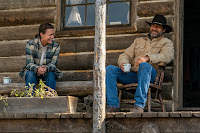
Her character comes quite close to meeting a painfully gruesome and untimely end, and then she’s saved by a shy and kind-hearted local hunter named Miguel (played by the extraordinary Mexican actor Demián Bichir) and his caring but skeptical friend Alawa (Sarah Dawn Pledge), who’s a nurse in a nearby town. After Edee’s health gradually returns, Edee and Miguel become friendly over time and begin to open up to one another, with all the right notes of chemistry and trust between the actors, until Miguel eventually disappears from Edee’s life without notice or explanation. She soon persuades herself to try to track him down, once she’s feeling fortified enough to interact with other human beings again and face civilization. I typically resist movies that seem to pile on the heaviness, but where the film went next in briefly re-connecting Edee with Miguel made perfect sense to me, again an absolute testament to the strength of the acting. By the end, the movie becomes a study in grief and how we navigate it, share it, help each other survive it, and then if we’re lucky, how we attempt to emerge from the shadow of it and move on. Although the source of Edee’s grief is far more tragic than anything that I’ve ever lived through, I related instantly and intuitively to her feeling of being unable to persist anymore, and I felt inspired by how she finds a sense of resolve through her friendship with Miguel to gently push herself forward. Not many films have made me cry twice, but
Land was one of them.