Friday, June 13, 2014

Heights (dir. Chris Terrio, 2005)

As I begin preparing to review some films at next week’s annual Provincetown International Film Festival, I’m also recalling some films that I enjoyed most in the festival’s previous years.  Back in 2005, I remember loving the festival’s closing night selection, Chris Terrio’s Heights, which also received the festival’s HBO Audience Award for Best Narrative Feature that year.  Terrio has gone on to great acclaim in the decade since then, winning an Oscar for writing the adapted screenplay of Ben Affleck’s Argo.  Earlier in his career, Terrio also worked as an assistant to James Ivory of the production team Merchant Ivory, so he was offered the opportunity to direct Heights because the late Ismail Merchant was producing it.

A fast-paced, stylish story of the intersecting lives and loves of an enclave of artsy, upper-crust New Yorkers, Heights is a finely balanced ensemble piece that focuses closely and intelligently on its characters.  Having watched the film a few times since originally seeing it in 2005, I’d say now that the movie is actually about its performances.  The film’s screenplay was adapted (and expanded) by Amy Fox from her 2000 one-act play of the same title, which centered on a rooftop confrontation between its three main characters.  For the film, Fox constructed the story leading up to that climactic scene, adding a number of characters to enliven the story along the way.  Terrio then gave the movie’s actors plenty of leeway to help craft and integrate those additional characters, and in some cases the actors even made decisions that altered the various directions of the plot.


The main connecting point in Heights is Isabel (Elizabeth Banks), a young photographer who’s experiencing some frustrations over her work and romantic life.  She’s engaged to be imminently married to Jonathan (James Marsden), a handsome attorney who’s also clearly experiencing some frustrations of his own.  Early in the film, it’s revealed that Jonathan had some past professional involvements with a famous photographer named Benjamin Stone.  A museum retrospective of Stone’s work is about to be mounted; many of its images are of beautiful young men, in the style of fashion photographers like Herb Ritts and Bruce Weber.  Stone has sent his boyfriend Peter (John Light) from London to New York to track down and interview the photographs’ subjects, most of whom are Stone’s ex-boyfriends, for a Vanity Fair article that will promote the exhibition.

The intrigues only deepen from there.  A struggling young stage actor named Alec, played by Jesse Bradford, happens to live in the same apartment building as Isabel and Jonathan.  Years ago, when I first saw boyish Jesse Bradford starring in Steven Soderbergh’s excellent 1993 family drama King of the Hill, I knew that he’d grow up to land a mesmerizing role like Alec someday.  Alec auditions for a new play that’s to be directed by superstar actress — and Isabel’s mother — Diana Lee, portrayed as just over-the-top enough by Glenn Close, in full-on diva mode.


Post-audition, Diana admits to Alec that she thinks he’s adorable and invites him to her Macbeth dress rehearsal that afternoon, as well as to a party that she's hosting at her home later that evening.  She justifies her interest in Alec due to her husband’s infidelity with her own Lady Macbeth understudy, effectively opening their marriage.  Diana’s consoled by her Macbeth director and longtime friend Henry (Eric Bogosian), who’s more interested in the hunky stagehands himself.

Heights is obviously a tricky movie to synopsize.  Terrio’s use of split-screen diptychs in a few select scenes highlights this complexity.  A handful of secrets are also divulged as the film unfolds, though some viewers may predict its plot twists long before they’re unveiled.  While I was engaged enough by the characters and story to be surprised by the turns when I first saw the film, I once showed the movie to a date who had figured out everything less than halfway through it.


But again, the performances for me are the film’s real focus.  James Marsden’s brooding Jonathan needs to be more gorgeous and transfixing than the women in the movie for several key reasons, and he and his tireless cheekbones unassumingly rise to the occasion.  Elizabeth Banks also feels just right to me as Isabel; she’s the character whose interior life matters the most to the audience in the end, and she believably embodies a wide range of emotional states and subtle changes that would be difficult for any actress to inhabit.  In an especially powerful scene when she makes the mistake of taking an impromptu subway photograph of a woman who’s gently stroking her daughter’s hair, Banks gradually builds up to the moment in a way that reveals how much her character is longing for a life that’s different from the one she has.

Many of the film’s smaller performances and cameos are equally riveting.  What a fun little bonus the musician Rufus Wainwright is as Jeremy, one of Benjamin Stone’s many exes.  Rufus has no problem whatsoever slipping into the role of a jaded, chain-smoking young queen — and one who hilariously hits on Peter (without success) while being interviewed by him.  Screen veterans like Isabella Rossellini, as the no-nonsense editor of Vanity Fair, and George Segal, as Jonathan’s patient and supportive rabbi, make colorful appearances, too.  Even The Big Bang Theory’s Jim Parsons shows up briefly as Alec’s chatty gay sidekick at a nighttime catering gig.

New York City, and its vast yet close-knit underground of interconnected subcultures, becomes an important character itself as the film progresses.  I’m peripherally familiar with the New York art and theater worlds, and the film’s representation of them feels dramatically heightened but also fairly accurate:  everybody knows everybody, or knows somebody who knows everybody.  The lapidary structure of Heights plays around with that notion quite adeptly, so it’s clear that Fox and Terrio were both at ease with and critical of that social terrain; the big party scene at Diana’s ritzy penthouse probably illustrates this best.  Jim Denault’s subdued yet dazzling cinematography also offers some sweeping views of the city at dusk, dawn, and in between.


As for the aforementioned plot twists, I’d rather leave those undisclosed here, since they were certainly surprises for me on an initial viewing.  Let’s just say that the riddle of sexual identity in contemporary metropolitan life threads itself skillfully into the tale, and that the ever-complicated figure of the closet won’t be disappearing anytime soon.  Nevertheless, characters both younger and older are left with potentially reassuring resolutions and hopeful futures.

Saturday, May 10, 2014

Nik Kershaw, 15 Minutes (Eagle Records, 1999)

I’ve always been fascinated by just how securely music can fasten itself to a particular time and place.  Back in March of 1999, I bought Nik Kershaw’s brilliant album 15 Minutes at a funky little (and long-defunct) record shop called Sidewinder, which was located on St. Martin’s Court just off Leicester Square in central London.  The next day I took the Eurostar chunnel to visit some friends in Paris, and I listened to 15 Minutes on repeat non-stop for the entire duration of the three-hour train ride.  Ever since then, I’ve always associated the music on that CD with my one and only daytrip to the City of Light.  It’s hard for me to believe that the album was released 15 years ago now, although the journey itself does feel about that far removed in my memory.

I’d been a fan of Nik Kershaw’s earlier records, especially the English songsmith’s best-known track, “Wouldn’t It Be Good,” which was his only single to chart here in the U.S. back in 1984.  Over the three decades of his career since then, he’s released eight finely crafted studio albums, along with an acoustic greatest-hits collection.  I’ve always thought he’s one of the smartest pop songwriters around, and also among the most under-appreciated.  Though his first two albums for MCA Records, Human Racing and The Riddle (both released back-to-back in 1984), tend to get the most attention, I was more drawn to his two albums on MCA that followed:  1986’s phenomenal Radio Musicola and 1989’s unfairly maligned The Works.  Because of his quick output within this five-year span of time, Kershaw was unfortunately relegated to ’80s U.K. synthpop whiz-kid status and never fully shed that label.  I still feel that many of the songs he wrote and recorded in those days are pure pop genius, with an ear for melody and clever lyrical turns that are mostly unparalleled either then or now.


After a decade spent writing and producing songs for other artists, Nik Kershaw’s 15 Minutes was intended to be something of a comeback album.  For those who were still following his music at that point, it was certainly a comeback and much more; the album’s twelve new tracks retained all the verve and promise of Kershaw’s earlier pop records, but in a refined and maturely realized musical style.  Moreover, with its obvious reference to the infamous quotation by Andy Warhol, 15 Minutes offers a sharp analysis of the notion of celebrity itself, examining what exactly it means to be any sort of popular artist, and the price one pays, potentially, for inhabiting that kind of public persona and perpetuating our cultural obsession with fame.

The album’s contemplative yet upbeat opening number, “Somebody Loves You,” playfully explores how a performer interacts with his audience over time:  “I put my words upon their lips / I put my body at their fingertips / And it feels like somebody loves you / Somebody understands.”  Kershaw is clearly aware, of course, that an adoring listenership isn’t actually love at all, even when it feels like it is, but he also knows there’s a kind of mutual dependency that isn’t always such a bad thing either (“They know my face, and they know my name / They know my shamelessness but not my shame… / I need them much more than they need me”).  The song’s cheerful delivery and catchy guitar hooks belie its tongue-in-cheek interrogations of narcissism as Kershaw asks, “Who’s gonna love me when they’ve gone? / What will I do without my wishing well? / What will I say if I can’t talk about myself?”

A later song on the album, “Shine On,” asks similar questions in an equally intelligent fashion; its thoughtful approach and shimmering, percussive instrumentation captivated me from my very first listen.  The lyrics reflect earnestly and literally on the earlier period of Kershaw’s own solo pop career with a unique brand of introspection, addressing his younger self directly through a series of carefully arranged images and memories:

“I took a hundred and ten pictures of you
I put them all around me and wondered what to do
Like a temple in memory, a shrine in your name
To days I can’t remember, to nights I can’t reclaim
I took a part of my life about 18 years long
I pulled it all to pieces and tried to make a song
With a groove you could dance to, a tune you could hum
I sang to my reflection, looking for the one.”


“Somebody Loves You” and “Shine On” both fit well with the album’s larger theme, which isn’t so much a midlife crisis as a bold midlife reassessment.  Kershaw seems to wonder what his former successes as a pop artist meant, as well as where exactly they went, but he doesn’t stop there, situating those ideas amongst the more personal aspects of his life.  The rapid-fire and outright comical “Billy” ponders how men operate once settled into their married years (“He’s got one face he keeps for his woman / And one for when he’s out with the guys… / He reads Marie Claire at the doctor’s / Just in case there is something he should know”).  “Have a Nice Life” is a simple yet moving meditation from a father to his son, just as the son is preparing to make his own way out into the world.


Appropriately appearing halfway through the album, “What Do You Think of It So Far?” is another self-addressed inquiry about making changes midstream:  “You’ve had it all and you’ve wanted more / You’ve had nothing and you’ve wanted for nothing… / Do you wonder if there might be something better?”  On the more somber “Fiction,” Kershaw looks back over his past once again and finds it all quite surreal and difficult to believe.

Naturally, the album culminates in its closing title track, a spirited and rollicking countdown (“One-quarter hour to get it all together / Nine-hundred seconds to make your bed / 15 minutes to show the world… / Throw me money, I’ll live forever”).  The song swirls into a chorus of guitars, chanting, and applause until it’s abruptly shut down by an old-style alarm clock ticking and finally buzzing the listener awake.  On the album’s U.S. release, however, the alarm clock segues into a beautifully arranged acoustic version of Kershaw’s biggest hit, “Wouldn’t It Be Good,” the song that continues to extend Kershaw’s 15 minutes of fame over thirty years later.

Wednesday, January 8, 2014

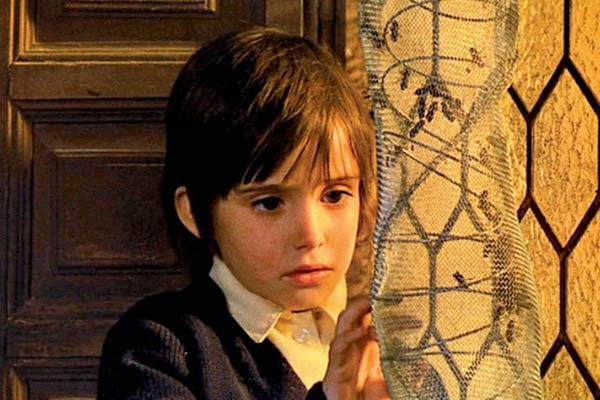
The Spirit of the Beehive (dir. Victor Erice, 1973)

Víctor Erice’s debut feature, The Spirit of the Beehive, is an acknowledged masterpiece of Spanish cinema, and in my estimation, it’s also one of the finest films of the 20th century.  It plumbs the mysteries of childhood more hauntingly and more convincingly than any other film I’ve seen.  Set on the Castilian plain in the remote village of Hoyuelos circa 1940, in the immediate wake of the Spanish Civil War, the movie is distantly possessed by the ghost of Francisco Franco, who ruled Spain as a dictator for over thirty-five years, from the period in which the film takes place until his death not long after the film’s release.  The director Erice himself was born in 1940, and many of the film’s details were inspired by his own childhood memories.

According to historians of Spanish cinema, the films produced in the country after the Spanish Civil War suffered greatly under Franco’s oppressive regime.  Political plots or themes often had to be subtly coded or presented allegorically, to avoid being construed as critical of governmental power.  The figure of the Fugitive — who drives the dreamlike last half-hour of the film and transfixes its central character, a young girl named Ana (played by Ana Torrent) — is among the few political elements of the movie.  Wounded while jumping from a train and later executed by military officials in the dark of night, the Fugitive is suggested to be a member of the anti-Franco resistance movement of the time.

But again, The Spirit of the Beehive is a film that’s deeply and intricately concerned with childhood first and foremost.  Appropriately, any political content is muted in a handful of scenes that unfold in near-total silence.  Viewed through a child’s eyes, as the entire film is intended to be, such political issues of the outside adult world make no logical sense; in the movie’s narrative as in life, those issues are soundless, voiceless, a kind of solemn charade.

Which brings us, fortunately, to the film’s major focus:  the daily — and nightly — experiences of Ana and her slightly older sister, Isabel (played by Isabel Tellería).  The world evoked in The Spirit of the Beehive is a thoroughly palpable one, despite the ethereal aura of strangeness that pervades many of the movie’s most memorable scenes.  Erice understands how children view and begin to interpret the world.  In our earlier years, we look around and see the world just for what it is, a succession of objects endowed with their own symbolic power, before we start to piece together, curiously, what exactly those objects mean.  If we come upon an abandoned well, we yell down into it, then throw a stone at the motionless water to see what will happen.  If we find a lone stretch of train tracks, we place an ear on the steel rail to hear if the train is approaching, then stand as close as we can to the tracks as the locomotive rushes past.

There’s more than a hint of danger in these depictions, and Erice lets that discomfort and uncertainty linger as his two young actresses perform the scenes.  This tension is both supplemented and counter-pointed by Luís Cuadrado’s bleak yet grippingly visceral cinematography.  An endless furrowed field, dotted with a few solitary and otherworldly shade trees.  A rundown stone shack with two black rectangular portals for doors.  At the far end of a different field, a standing wall of some other demolished stone building, pierced by occasional gaps and holes.

The film’s long spans of silence are like those occasional gaps and holes.  Its narrative involves a family of four — the two aforementioned daughters, their beekeeper father Fernando (played by Fernando Fernán Gómez), and their quiet, letter-writing mother, Teresa (played by Teresa Gimpera).  Film scholars have noted that Erice never shows the whole family together in a single frame.  Even when all four characters are eating together at the breakfast table, each actor is filmed individually, emphasizing the sense of relaxed separation within the household.

Another important character is the physical home where the family resides, an imposing block of an estate (complete with battlements on the roof), a remnant of some bygone, more prosperous era.  The doorways and passages of its many rooms all seem to line up directly with one another, in contrast to the austere quietude and estrangement in which its four inhabitants often live.  Its golden windows are designed with hexagonal metal seams, a visual and metaphorical echo of the beehives with which the children’s father is seen working early in the movie.

The plot of the film is structured around the image that opens the narrative:  the arrival in Hoyuelos of a truck that’s delivering a movie to the village’s one-room cinema.  That movie, from which several key clips are deftly re-inserted and recreated, is James Whale’s Frankenstein.  Indeed, the genius of Erice’s The Spirit of the Beehive is this joyfully self-referential device; from the movie’s inception, he makes us aware that his own film is a meditation on the power of cinema to alter our imaginations.  The scenes of Ana watching Whale’s Frankenstein were filmed while the young actress Ana Torrent was actually seeing Frankenstein for the very first time herself.  Ana’s genuine look of awe and surprise when the girl by the lake hands Frankenstein’s creature a flower propels the wonder of Erice’s film.  The idea of whether the monster is real, whether or not he killed the girl and then died himself, and whether or not he lurks somewhere at the edges of their village, keeps Ana’s mind faithfully in pursuit of him from that point onward.

Later in the film, after her sister Isabel pulls a cruel but typical childhood prank of “playing dead” — a traumatizing moment at which Ana can find no adult in the house to help her — Ana’s connection to reality gradually unhinges.  She wanders away from home and stumbles upon the wounded Fugitive hiding out in the rundown stone shack in the sprawling, rutted field, conflating him with her image of Frankenstein’s creature, someone she can sneak away to care for and, unlike her stern-faced father, grow closer to. Of all of Ana’s encounters with her emerging notion of mortality throughout the film (her sister’s prank, the girl by the lake in Frankenstein, foraging for wild mushrooms with her father and sister to learn which ones are poisonous), the murder of the Fugitive, which she reads as her father’s punishment and betrayal of her at once, is the death that’s most indelible.

The movie powerfully encapsulates the pivotal moment in childhood when we realize that life does not go on indefinitely but ends, sometimes even violently and abruptly.  How Ana copes with that realization is the magic of the film’s spellbinding final scenes.  As a philosophical voiceover early in the film foretells, The Spirit of the Beehive dwells in a place beyond the clouds and stars.

Saturday, December 21, 2013

Aztec Camera, Love (WEA Records, 1987) and Dreamland (Sire/Reprise Records, 1993)


Alongside Scritti Politti’s Cupid & Psyche ’85 and The Blue Nile’s Hats, Aztec Camera’s 1987 album Love is one of my three favorite albums of all time.  That all three acts hail from the United Kingdom, and that two of the three hail from Scotland in particular, is probably no coincidence.  Brits have long adopted soulful American musical forms, then perfected and polished them to a fine and glowing sheen.  This is still true today, but it was especially true back in the 1980s.  (Next on my list of favorite albums, in fact, would be 1988’s Idlewild by Everything but the Girl, yet another soulfully sublime ’80s U.K. outfit.)  I’m sure these albums stand out the most to me because I was coming of age during exactly the years when they were all released, a time when the world of popular music seemed fresh and inspiring to me, a time when my world itself felt as if it were expanding rapidly and magically outward.

The Scottish singer/songwriter Roddy Frame formed Aztec Camera in 1980 when he was only sixteen.  I’ve never bothered to look up the story behind the band’s enigmatic name, preferring, as Iris DeMent once wisely sang, to “let the mystery be.”  By the time Aztec Camera’s third album Love was released in 1987, Frame was the sole remaining member of the group.  From that stage onward, he worked with various carefully selected session musicians when recording his albums.  The nine pristine songs on Love benefit greatly from this approach, most notably with the powerhouse, R&B-spiked background vocals provided by such singers as Mtume’s Tawatha Agee and the late Dan Hartman.

At this point Roddy Frame was considered a certified popstar and something of a heartthrob in his native U.K.  The album Love was crafted with this in mind and also easily transcends that image.  As the album’s title almost cheekily makes clear, the thematic through-line is obviously nothing earth-shaking, and Frame’s lyrics dutifully follow suit, equally lovestruck and lovelorn.  He’s singing to the screaming girls in the audience, after all, but he’s also singing back to the pop music of the past.  Nor does Frame’s musicianship disappoint.  His boyishly warm vocals fit the matinee idol aims, while his agile guitar playing on the swooning opener “Deep & Wide & Tall” and the funk-infused “One and One” prove that he’s way beyond some random boyband leftover.

A few of the production credits are a bit surprising, too.  For instance, David Frank, famous for his work with the ’80s pop/dance duo The System, helms two of the album’s breeziest tracks, “How Men Are” and “Paradise.”  “How Men Are” captures the album’s mood especially well (“It’s called love / And every cruelty will cloud it ... / ‘Cos it’s a lie that we have ceased to believe / We’ve said goodbye but it won’t take its leave”).  The album’s pinnacle, however, is definitely the more pensive “Working in a Goldmine,” built around a shimmering slow-drip of a groove, as Frame muses over trying to hold onto love in the fast-paced touring life of the music business:

“Waiting on the last train
Flicking through the highlights
Livin’ in a suitcase
Positively uptight ...
‘Cos I believe in your heart of gold
Automatically sunshine
Glitter, glitter everywhere
Like working in a goldmine.”

It’s appropriate, then, that Aztec Camera’s 1993 album Dreamland begins with the following words from its opening number, “Birds,” nearly a kind of clever self-parody:  “‘Hey baby baby bring your love to me’ / Repeats the radio relentlessly .... ”  Frame had mastered not only his line of work by now, but also his sense of humor about it.  (Actually, an intervening Aztec Camera album titled Stray was released in 1990, and though I do admire that one, too, I don’t find it as perfect or as streamlined as Love and Dreamland both are.)  The most significant move on Dreamland, nevertheless, is Frame’s distinctive choice of producer, the celebrated avant-garde Japanese composer Ryuichi Sakamoto, who endows the album’s eleven songs with the gossamer, dreamlike soundscapes that its title promises.

Frame’s cascading guitar introduction on “Black Lucia” swerves noticeably in the direction of Robin Guthrie of Cocteau Twins, whose albums had begun to find quietly mainstream notoriety by the time Aztec Camera’s Dreamland came into being.  “Spanish Horses,” one of the album’s most instantly recognizable cuts, dances in another direction altogether, with Frame’s nimble acoustic guitar work taking on practically Flamenco inflections.

Sakamoto’s influence feels most palpable on a song like “Sister Ann,” underscored by a synthesized lull that pervades every layer of the music, as well as Frame’s vivid, imagistic lyrics:  “When days are just a trail of clothes / Slung over poetry and prose / A red reminder of the things I owe / A songbird silenced in the settling snow ... / I stood inside of something I’d outgrown.”  The penultimate track, “Valium Summer,” is my favorite song from Aztec Camera’s catalog (including the terrific solo albums that Roddy Frame has released under his own name since retiring his Aztec Camera moniker after 1995’s Frestonia).  “Valium Summer” is one of those rare pop songs that invites you into its melancholy spell and then never quite releases you, allowing you instead to trace the musicians’ own emotional shifts from moment to moment:

“Where the streets just sparkle silently
And leave the lovers to the night
Remembering how they came together
With such violence
Felt so good they did it twice
Too early for September songs
But much too late for love to bloom .... ”

Tuesday, August 13, 2013

The Act of Killing (dir. Joshua Oppenheimer, 2012)

I wouldn’t be at all surprised if The Act of Killing wins the Oscar for Best Documentary.  It should certainly be nominated at least, unless it’s the kind of documentary that travels too close to the edge to receive that sort of mainstream awards-ceremony attention.  This brave and deeply powerful film — which both re-enacts and comments in detail on the government-sponsored massacre of thousands, perhaps millions, of suspected Communists and ethnic Chinese throughout Indonesia in 1965 and 1966 — is directed by American-born filmmaker Joshua Oppenheimer (who currently lives overseas), and is executive-produced by master documentarians Werner Herzog and Errol Morris.

I knew Josh when we were both in college here in Boston nearly twenty years ago now, and we went out on a couple of dates back then.  I remember how smart and precocious he was, easily drawn to the bizarre, and always unassumingly dressed in all black:  from boots to jeans to t-shirt to leather jacket.  I recall how he had scrawled a variety of slogans and snippets from poems across his dorm-room walls.  He told me at the time that he was interested in the act of politically infiltrating certain kinds of spaces.  For instance, he had attended an “ex-gay” camp just to gauge the atmosphere and see what actually happens there, and to what sort of people.  His student films were totally offbeat and distinctively envisioned, and I knew that he’d probably do something important and fearless someday.  With The Act of Killing, he most definitely has.

Josh’s work on the film began a decade ago, when he was commissioned to make a documentary series about globalization and Indonesian culture.  He learned to speak the language that way, and he was also introduced over time to his film’s subjects, the men of a paramilitary organization called Pancasila Youth who had carried out the 1965 - 1966 massacres and still boast about the killings with pride to this day.  Many are now employed and protected as officials of the Indonesian government, often terrorizing victims’ families into not discussing or publicly acknowledging the crimes.

Oppenheimer noticed that whenever he met and interviewed these men, their telling him about the murders was never enough; they wanted to show him how and where they’d committed their crimes.  Sadly, some in Indonesian culture still regard them as heroes.  At one point in the documentary, we see a handful of these men paraded onto the set of a nationally televised talk show, where their killings of long ago are reverently applauded by the host and the audience.

It’s partly for this reason that Oppenheimer has said the film is not about Indonesia’s past, but rather about Indonesia’s present.  His focus in the film is a man named Anwar Congo, who executed by hand over 1,000 of the killings in Medan, North Sumatra.  Though his age (and grandchildren) have somewhat softened and tamed him, Anwar makes for a chilling figure.  He’s happy to demonstrate for the camera, on multiple occasions, how he strangled his victims with wire, in order to minimize the loss of blood while they were being killed.  He stages these demonstrations in the very same locations where he originally committed the killings.

For anyone with a shred of conscience, which Oppenheimer was clearly aware that Anwar Congo still possesses, such re-enactments will eventually begin to exact their own psychological price.  But the true genius of the film is how much further it carries the scope of the re-enactments themselves.  (And it’s worth noting that the filmed re-enactments were funded by grants from academic and human-rights organizations.)  The templates for the re-enactments are often classic Hollywood film genres:  Westerns, gangster flicks, film noir.  The most elaborate re-enactment features the original members of Pancasila Youth pillaging and burning down an entire village.

I haven’t stopped thinking about how trenchantly effective this device is since I watched the documentary a week ago now. The Act of Killing is a film in which the medium of film itself forces the documentary’s subjects into a gradual confrontation with their own sense of morality, especially in the case of Anwar Congo.  In the film’s pivotal gangster-based sequence, Anwar plays the victim who’s being beaten by his scenery-chewing sidekick Herman Koto, and yes, Anwar is eventually blindfolded and subjected to his own death-by-strangulation-with-wire technique.  The perpetrator has willingly backed himself into his own gruesome corner, one that he can barely muster the energy to stagger away from thereafter.  Early in the documentary, Anwar excitedly claims, “No other film has ever used our method,” and he’s absolutely right about that.

Another of the Pancasila Youth members who’s interviewed in the film is worth mentioning, too: Adi Zulkadry, perhaps the most articulate, outspoken, and frightening of the documentary’s interviewees.  Defiantly unapologetic about his past crimes, he gets into a heated argument on camera with Oppenheimer as they’re driving together in a car.  Zulkadry throws out the old line that history is written by “the winners” and says that he’d be glad to be put on trial at the international court in the Hague because then “I’ll be famous.”  To prove his hegemonic point, he challenges Oppenheimer, staring directly into the camera, and rhetorically asks him why the mass genocide of Native American Indians in the United States was never punished either.

From this point onward, the film becomes increasingly nightmarish and surreal, and it also cuts much closer to the bone.  Some dreamlike song-and-dance numbers are interspliced with the brutal re-enactments in artfully hyperrealistic counterpoint.  But Oppenheimer knows that his job for nearly the entire time is to be an alert observer.  We never see him on screen, though we do hear his voice a few times when he’s directing, responding to, or sometimes interrogating his subjects.

At the most profound moment in the film, after Anwar requests to watch a video of the gangster re-enactment on his television (with his two young grandsons sitting on his lap), he remarks that he does feel what his victims felt, almost as a way of trying to convince himself of his own sense of empathy.  Josh calmly (yet incredulously) replies that, no, Anwar does not feel what his victims felt because he knows that he’s only acting for a film, whereas his victims knew that they were being killed.  The film’s climax, in which Anwar physically acknowledges but cannot expurgate his guilt, is excruciating and unflinching.

The Act of Killing will no doubt alter the game rules for the documentary form, opening it up to an intense, imaginative realm that’s never quite been approached. It’s among the most indelible explorations of moral accountability I’ve seen.

Friday, July 19, 2013

Orchestral Manoeuvres in the Dark at Paradise Rock Club (July 15th, 2013)

It’s been three years since I’ve written a concert review for my blog, so it’s time again for me to crank out another one of those.  On Monday night I was totally excited to see OMD perform, having been a fan of their music for the past three decades now.  Even so, I’d have bought a ticket solely on the strength of their latest album, English Electric, one of my favorite CDs so far this year.  The songs are a futuristic throwback to their astoundingly good ’80s catalogue, with a number of the best tracks even stealing bits and pieces from their early hits, so an evening of live music with the duo is an ideal way to tie it all together and bring things full circle.

The crowd was understandably older than I’d usually expect to find at a pop band’s club show.  A scattering of younger listeners drifted around the venue, however, including one guy standing next to me who said that he’d never heard OMD’s music until earlier that day, when he listened to their songs online for a few hours in his office and decided to attend the concert.  He said he was there for the “’80s techno,” and I doubt that he left disappointed at the end of OMD’s 90-minute set.  Andy McCluskey (on vocals and guitar) whirled around the stage in jeans and a white button-up shirt, while Paul Humphreys (on keyboards) played the deadpan Chris Lowe supporting role dressed all in black.  The pair offered up a generous sampling of their classic crowd-pleasers like “Tesla Girls,” “So in Love,” “(Forever) Live and Die,” “Sailing on the Seven Seas,” and an encore of “Electricity.”

I was perhaps most excited to hear OMD perform 1981’s “Souvenir,” one of the most perfect electronic pop songs ever to come out of the United Kingdom.  Interestingly, it was also the only song of the night that was sung by Humphreys.  “Souvenir” segued sensibly into “Night Café,” probably my favorite song on English Electric, which borrows several different sonic elements from that earlier track; McCluskey mentioned during its introduction that the lyrics of “Night Café” were inspired by the paintings of Edward Hopper.  The other songs featured from English Electric sounded equally fantastic in a live setting, especially the euphoric opener “Metroland” and the propulsive “Dresden.”  I also loved how electronic interludes like “Please Remain Seated” and “Atomic Ranch” were effectively woven into the set-list.

One more new song is worth touching upon because it captures OMD’s current thematic focus:  the cyber-transformation of contemporary culture and the ultimate destination of the cosmos.  “Our System” may be the most ambitious song that the duo played on Monday night.  It’s about the Voyager interplanetary space probe as it moves through our solar system and continues across the universe, “only to perceive / no one there at all.”  The rhythm is even based on the Voyager’s sound recording of Jupiter’s magnetosphere, “the sort of thing that we like to write songs about,” McCluskey joked.  (By the way, his singing voice has changed remarkably little over the years.)

The moment that I’ll remember best from the night, however, is hearing the audience sing along with the lyrics of “If You Leave,” easily OMD’s biggest commercial hit here in the United States, written for the soundtrack of John Hughes’ 1986 teen movie Pretty in Pink.  Yes, I’m aware that “If You Leave” is reviled as a sell-out song by many longtime fans of OMD’s music.  And yes, I’m also aware that OMD wrote it in under 24 hours when they realized a different song they’d composed wouldn’t be the right fit for the film.  But I was thirteen when I saw the movie at the cinema, so my own associations with the first time I heard “If You Leave” soar into Molly Ringwald’s prom scene finale are inviolable.

I’ve always been skeptical about anyone who’s overly critical of nostalgia.  Marcel Proust aside, in a sense nostalgia is impossible to intellectualize because it’s purely about feeling.  A recent New York Times article on the science of the phenomenon concluded that nostalgia — which literally means “the pain of going home” — is psychologically healthy to experience.  Those who nostalgize in times of depression overwhelmingly find themselves feeling better as a result.  There’s a clear correlation to the power of music as a tool for creating good memories, of course.  When the heroine of Pretty in Pink fashions her own prom dress and decides to attend the dance alone in defiance of the rich bullies at her school, OMD’s “If You Leave” underscores her bold proclamation to her dad: “I just want to let them know that they didn’t break me.”  I certainly felt that myself in high school, and judging from the audience’s reaction to hearing “If You Leave” in concert on Monday night, plenty of other people felt exactly the same way.